
Litir Chumhdaigh
I refer to the above and to the Draft County Development Plan 2023 – 2029 for County Kildare, which was recently published. We make the following submissions thereon: -
(See attached for full response document in Word format)
Chapter 1 – Introduction
MEANINGFUL PUBLIC PARTICIPATION
Onus to implement submissions: Kindly note that the public are invited participants in this process. Please also note that people have voluntarily given of their time to do all of this work on a pro bono basis.
Ireland and the EU have signed up to numerous international conventions, which guarantee public participation. The Aarhus Convention (ratified in June 2012) is particularly pertinent in this regard.
Having regard to these facts, we are most concerned that this is not merely a box ticking exercise and that these submissions be fully considered. In the interests of transparency it would be essential that where important points within this and other voluntary submissions not be taken on board, that full and proper explanations as to why they are omitted are provided. Indeed the absence of such may provide clear grounds for judicial review.
Strategic Environmental Assessment: we inquire whether any strategic environmental assessment [SEA] was conducted as part of the County Development Plan [CDP] which takes an overall look at items of where aggregates are to come from and where sustainable energy is to come from. We have seen a plethora of developer led applications for solar parks and wind energy installations. This is extremely problematic in that there is a significant land-take during times when arable land is extremely important. Experience has shown that applications for individual solar installations are looked at in isolation and not as a whole. The same goes for wind proposals. When at the same time deep-bore geothermal has been ignored despite the fact that it is far more sustainable than either wind or solar (both of which can only provide intermittent energy while geothermal can provide constant (dispatchable) energy.
Agricultural/ arable land is an extremely valuable resource for the production of crops. The importance of sustainable homegrown crops has recently come to the fore in light of the war in Ukraine. It transpired that Ukraine was supplying vast quantities of cereals to Europe and there is now a very strong likelihood of food shortages as a result of the Russian aggression towards its neighbor Ukraine. It will be noted that Irish farmers were in the spring of 2022 encouraged to sow more cereals to help bridge the gap. In the circumstances, to use up so much finite agricultural land with solar panels would be irresponsible and wrong. Given that so much roof spaces are available to support solar panels, there are alternatives.
Our experience has been that there has been little or no enforcement of planning permissions when they are granted to quarry operators and worse still that there has been little or no enforcement of unauthorised quarries either. This compares to other sectors of society who will likely have a representative from the County Council out to inspect them for the smallest of alleged planning infringements. The environmental and social impacts of poorly regulated quarries have been enormous and will be there forever (unless and in the unlikely event that they are filled in). There are usually open water bodies left which: -
- Will be a safety hazard; particularly so for children who often see these as a swimming pool; there have been many drowning’s.
- Act as a pathway to contamination of the groundwater aquifer,
- Deep quarry lakes are a perfect way to dispose of incriminating evidence.
- Are of course also visually obtrusive,
Sustainable Development: We note that the development plan places an emphasis on sustainable development, which is to be welcomed. There needs to be much more about Deep-bore geothermal energy though.
SUSTAINABILITY
- There are numerous references to ‘sustainability’. While this is welcomed, be found them too aspirational and lacking in detail.
We have concerns about the following social issues: -
‘Build to Rent’ developments are large-scale developments that have the potential to deliver residential accommodation at a pace and scale significantly greater than that of the more traditional developers.
‘Shared accommodation or ‘Co-Living’ consists of professionally managed rental accommodation where individual rooms are rented within an overall development that includes access to shared or communal facilities and amenities.
A number of references have been made to social housing in the actual policies. This is to be welcomed. BUT, we are most concerned that aspects of the above referenced statements in the text that preceded the actual policies.
Vulture Funds: While rental property is essential, we are aware that ‘Build to Rent developments’ have been promoted by so called vulture funds / hedge funds. This is frankly unacceptable. This type of landlord is not much different to what Ireland prayed off vulnerable tenants in the 1800’s.
BUILD TO RENT SCHEMES
On the Tuesday, 18th February 2020, RTE’s John Kilraine reported that a new build-to-rent development at Clongriffin in north Dublin comprising 376 rental units had been completed and that ‘The first 117 tenants did not physically see their new homes before moving in as the rental agreement had already been completed’. RTE further reported that the development was ‘managed by Vesta and was built by its sister company Twinlite with funding from British investors’…’The monthly rent is €1,550 for a one-bed, €1,990 for a two-bed and €2,499 for a three-bed.’
Reference: https://www.rte.ie/news/2020/0218/1116105-vesta-apartments-twinlite/
- Most of the accommodation is for single people.
- Meanwhile, what about Irish families growing up in hotel rooms?
- These developments are not family friendly!
- Moreover the rental income is flowing out of the country.
- This is frankly ludicrous and a mirror of what Ireland fought so hard to rid itself of in the 1800’s.
- The new Development plan should proscribe such developments.
- Irish people should be afforded the dignity of owning their own home.
We submit that a policy specifically proscribing this form of ‘investor’ / ‘landlord’ from building anywhere in the County of Kildare. It might read like: To support the common good, it shall be the policy of the County Council to promote the private buy to rent sector in preference to investments funds.
Shared accommodation or ‘Co-Living’: This is an unacceptable form of accommodation and should not be permitted under ay circumstances in the county. There are all sorts of social issues with this type of accommodation, which offers little more than shelter. It is another form of profiteering on the backs of vulnerable individuals and deprives them of a basic level of dignity. We are aware of one development in Dublin where a site was previously permitted for 40 apartments. In December 2019 the applicants applied for a 121-unit co-living development in the north inner city. It would see communal kitchens shared by up to 17 people. This scheme for 121 co-living units at a derelict site on Mountjoy Street would see between 14 and 17 people sharing a kitchen and paying €1,300 a month. This is unacceptable in any County.
It is submitted that a specific policy be inserted into the County Development Plan proscribing this type of development in the county by reason of social issues and also incompatibility with the counties heritage status. It might read like: To ensure that living standards are upheld in the county it shall be the policy of the County Council to prohibit the development of co-living accommodation.
Densities: While Building at higher densities makes more efficient use of land and allows for a more compact form of development that supports and maximises investment in critical infrastructure such as public transport. Sound insulation continues to be problematic in that neighbours can still hear noise from each other through the inadequate walls. We also witnessed a modern estate house burned over the Christmas of 2019. Of note was the fact that the houses on either side were also badly damaged. This all points to improper and insufficient insulation and division between the properties. Its all very well for policy to encourage better use of land space; but it is imperative that corresponding policies mandate that additional insulation and sound proofing be included in the build (irrespective of what building regulations state as these are currently wholly inadequate in this respect).
Therefore it is submitted that a policy be inserted along the lines of: - It shall be the policy of the County Council that all buildings are adequately insulated to prevent sound from travelling beyond their living area so that others can peacefully enjoy their living space in comfort.
We further recommend that a policy be added to the effect that new build be insulated to a standard such that they require minimal artificial heat. A policy that all new builds be fitted with heat recovery air conditioning systems to improve the health of those living in them. This might read like: - It shall be the policy of the County Council that all buildings are adequately insulated and fitted with heat recover systems so that heat loss is minimal and the need for artificial heat is minimised.
Industrial development should not have a detrimental impact on the lives of people living in the county. The quality of people’s lives should therefore be prioritised.
New housing developments should be built to foster community feeling and be arranged so that children have a place to play outside where they can be supervised by their parents glancing out the window. Appropriate housing mixes can improve neighbourly behaviour and reduce feelings of isolation, especially if houses can accommodate people at different stages of life e.g. bungalows for older people who can’t manage stairs.
ONE OFF HOUSES in RURAL AREAS
While we support the County Council in its endeavors to restrict housing in rural areas, there are occasions where it will be appropriate to grand such permissions. There has been much discussion in the public sphere of a minimum land holding size before an occupant would be permitted to construct a home. The figure of 25 acres has been mentioned as a minimum acreage before the council would consider a grant of planning. This would appear to be very arbitrary and fails to take account of horticultural industry norms, which typically require far less land. For example; 5 acres of ground can accommodate quiet a sizable nursery supporting the employment of many people. Likewise there will be other intensive rural enterprises, which will not require anything like 25 acres of ground. It is therefore recommended that this arbitrary restriction by reviewed with a view to accommodating the type of industry alluded to above.
DATA CENTERS
- Much of what is stated in this section appears fine and appropriate on the face of it. However there is an emphasis on development of Data Centers.
- Eirgrid: estimated that they will consume 30% of all electricity by 2030. This is way out of kilter with all other countries.
-
The expansion of data centres is causing a crisis in the security of supply of electricity. Most countries are seeing their electricity demand stagnate or decline; as their populations are stagnant or decreasing and energy efficiency is increasing. This compares with Ireland where we are seeing our electricity demand increase.
- This is due to data centres. This hasn’t happened before.
- Its always been the case that an increase was driven by economic activity;
- its never been the case that one particular sector just exploded our electricity demand in this way.
-
CSO statistical publication, 03 May 2022, 11am
- In 2015: Data centres accounted for 5% of metered electricity consumption,
- In 2021: Data centres accounted for 14% of metered electricity consumption (a near 3 fold increase).
- This compares to:
Urban Dwellings who accounted for 21% of metered electricity in 2021 and
Rural Dwellings who accounted for 12% of metered electricity in 2021.
6. Employment is often cited as a justification, in reality they employ very few people when they are up and running.
7. Data Centres: we are aware that the Department a document entitled:
‘Government Statement on the Role of Data Centres in Ireland’s Enterprise Economy’ which was published in June 2018.
This document makes numerous references to the need to change law re judicial review to encourage more data centres; this may in part explain the proposed amendment. This is a very flawed policy. Data Centres should not be encouraged for two reasons;
8. Electricity Usage: They use a massive amount of electricity; we are trying to reduce CO2 emissions on the one hand while on the other encouraging business that are resource intensive.
We enclose article published by the Guardian 6th January 2020 for your information.
Why Irish data centre boom is complicating climate efforts; published 6th January 2020, The Guardian
9. Security: we understand from information gleaned from security analysis's that having so many data centres in Ireland makes us a highly vulnerable target for terrorism. We also understand that there may well be agents from rogue states already on the ground here in Ireland waiting to be mobilised.
We enclose article published by the Irish Times of the 27th December 2019 for your information.
Cyber attack on Irish data centres would badly hit economy, report warns; published 27th December 2019, The Irish Times
10. We therefore STRONGLY oppose this flawed policy, which is counter productive in terms of the County’s reliance on energy and also exposes the county and its citizens to an unnecessary security risks of a grave kind.
Rail network: We would encourage upgrading of the rail network and with the objective of removing the necessity of people to travel by car.
Leinster Outer Orbital Route: That the orbital route concept is still on the drawing board is alarming. The construction of a motorway across a heritage county is nothing short of wanton vandalism, particularly at a time of depleting fossil fuel reserves and when greater emphasis should be placed on public transport system/s. The fiasco of the M3 motorway should have focused minds to this. In that case the exchequer had to subvert the takings on the tolls as traffic was below predicted levels. It would appear that the lesson has not been learned. We are aware that the outer orbital route still appears in regional strategies too. Notwithstanding, we are obliged to point out the obvious shortcomings with this policy.
We strongly oppose the continued insertion of this proposal.
We need to move away from roads to rail and other forms of public transport. Constructing motorways merely encourages this type of car dependant urban sprawl.
Moreover motorways give rise to significant noise and disturbance. We invite you to walk the Royal Canal between Enfield to Fury’s to listen to the noise disturbance, which the M4 motorway is causing.
Furthermore, the proposed motorway is planned to cross various sensitive landscape such as Doolistown Bog between Trim and Longwood. This is unacceptable and we are surprised that the county’s docile adherence to the TII (Transport Infrastructure Ireland) formally the NRA (National Roads Authority).
To run yet another 4-lane motorway across sensitive a heritage landscape is frankly ludicrous.
Cont/d.
Ground water: There is an absence of policy regarding adequate protection of groundwater aquifer in the case of water abstraction and water table drawdown by the extractive industry. There is for example no reference to dewatering to any given a.O.D. level. It is submitted that this might be properly informed and drafted by a qualified hydrogeologist. There has been a lack of proper hydrogeological consideration in planning permissions over the years with An Bord Pleanála overturning many County Council grants on the basis of inadequate hydrageological assessment.
RENEWABLE ENERGY
Sadly, every time green energy is mentioned, people immediately jump to wind. We have conducted significant research on numerous energy types. We state unequivocally that wind energy is utterly unsustainable and will not provide a solution for western energy needs. We are confident that in the fullness of time this assertion will prove to be correct. Regrettably there are many within the environmental sector who blindly promote wind out of some form of misplaced loyalty or political correctness without having bothered to properly investigate it. We have laid out hereunder a very CONDENCED rational for our position. By far the most promising is deep-bore geothermal. As we shall see, there are significant downsides to wind in that they are extremely resource hungry.
WIND ENERGY
The current wind energy strategy is driven by Irelands National Renewable Energy Action Plan [NREAP], which was submitted to the EU in July 2010 and details the renewable energy plant up to 2020. This is revised every 2 years based on whether Ireland is meeting its targets. As I understand it, currently renewable electricity ambitions are 40% of which 90% is to come from wind, which is ludicrous in the knowledge that there is a much more sustainable and less intrusive solution in the form of Deep-Geothermal.
ISSUES with WIND
- Extremely resource hungry.
- Wrecking the landscape visually and in consequence the touristic potential of Ireland. Note that tourist’s numbers in Scotland (where there has been much development of wind) have already taken a significant dive.
- Property devaluation (peoples homes).
- Certain health issues re people with certain conditions (asperger’s, etc), probable Health issues re infrasound re other people and so on.
- Enormous Public disquiet.
- Doubling capacity to provide for lack of wind.
- Significant payments to operators to turn off supply to harmonise grid.
- Significant grants to promote wind turbines (derived from levy on electricity bills).
Notwithstanding the above and approaching it from a clinical sustainability perspective, please note the follow: -
STEEL: To create 1,000 Kg of pig iron, you start with 1,800 Kg of iron ore, 900 Kg of coking coal 450 Kg of limestone. The blast furnace consumes 4,500 Kg of air. The temperature at the core of the blast furnace reaches nearly 1,600 degrees C.The pig iron is then transferred to the basic oxygen furnace to make steel. 1,350 Kg of CO2 is emitted per 1,000 Kg pig iron produced. A further 1,460 Kg CO2 is emitted per 1,000 Kg of Steel produced so all up 2,810 Kg CO2 is emitted. 45 tons of rebar (steel) are required so that equals 126.45 tons of CO2 are emitted. [See enclosure]
CONCRETE: To create a 1,000 Kg of Portland cement, calcium carbonate (60%), silicon (20%), aluminum (10%), iron (10%) and very small amounts of other ingredients are heated in a large kiln to over 1,500 degrees C to convert the raw materials into clinker. The clinker is then interground with other ingredients to produce the final cement product. When cement is mixed with water, sand and gravel forms the rock-like mass know as concrete. For the turbines currently being proposed, upwards of 200 lorry loads of readymix calculate are required to anchor each turbine (in addition to lots of reinforcing steel). [See enclosure]
ROADS: Infill for access roads: sourced from crushed rock derived from quarrying are also required.
RARE METALS: Each and every wind turbine has a magnet made of a metal called neodymium. The mining and refining of neodymium extraordinarily dirty and toxic – involving repeated boiling in acid, with radioactive thorium as a waste product – 90% of it comes from – Baotou, China. Neodymium is a rare earth metal, which is generally sourced in China and which is causing. There are c. 4 tons of neodymium magnets in each turbine for example. China’s Ministry of Industry and Information Technology estimated that the cleanup bill for southern Jiangxi Province could amount to 38 billion yuan, or around $5.5 billion. Only a fraction of that amount has so far been spent.
We invite you to read the following re
Rare-earth mining in China comes at a heavy cost for local villages
Pollution is poisoning the farms and villages of the region that processes the precious minerals
Cécile Bontron
Tue 7 Aug 2012 13.59 BST
https://www.theguardian.com/environment/2012/aug/07/china-rare-earth-village-pollution
Rare earth mining in China: the bleak social and environmental costs
China produces 85% of global supply of the 17 chemically similar elements crucial to smartphone, camera lens and magnet manufacture – and half that output is from the city of Baotou
Jonathan Kaiman in Baotou
Thu 20 Mar 2014 14.30 GMT
https://www.theguardian.com/sustainable-business/rare-earth-mining-china-social-environmental-costs
China Wrestles with the Toxic Aftermath of Rare Earth Mining
China has been a major source of rare earth metals used in high-tech products, from smartphones to wind turbines. As cleanup of these mining sites begins, experts argue that global companies that have benefited from access to these metals should help foot the bill.
JULY 2, 2019
https://e360.yale.edu/features/china-wrestles-with-the-toxic-aftermath-of-rare-earth-mining
The dystopian lake filled by the world’s tech lust
By Tim Maughan
2nd April 2015
https://www.bbc.com/future/article/20150402-the-worst-place-on-earth
Fluctuating wind supply: necessity for spinning reserve (a readily available back up source of power).
ESKERS: Most of the sand and gravel requirements in Ireland come from Eskers laid down in the last Ice Age. Sadly in the space of no more that about 2 generations, we have near exhausted all our reserves from these eskers without any thought for future generations. The situation is so bad in the UK and China (to mention but two other countries) that they have now resorted to dredging estuaries in an effort to get sand. Being the principle constituent of concrete, to see so much buried under wind turbines which will without any doubt become white elephants is utterly crazy.
Having regard to the foregoing, it is manifestly obvious that wind energy is not a long-term runner and is currently being artificially driven by significant grants, which serve only to create a rush for grants by investors and corporate’s driven purely by ‘returns’ piggybacking on the ‘Green’ label.
Moreover the sitting of the wind turbines in a county that markets itself on its heritage is utterly crazy and unacceptable. The midlands have significant populations, together with significant heritage sites, which is of enormous touristic potential.
If one were to persist with wind energy (even in some small manner), they should at the very least be prohibited in the populated and predominantly flat landscape of the midland counties.
We can understand why Wind Energy became the front-runner as it was perhaps the most visually obvious. However, when all the facts are viewed objectively, it is utterly crazy to persist with this strategy. As we have seen above, this is badly flawed. Moreover, the emphasis on wind is largely derived from a lack of public consultation early on in this debate, which is contrary to basic democratic principles and more recently to the Aarhus convention and the Public Participation Directive.
DEEP BORE GEOTHERMAL [6.15.3.3]
This is essentially ‘free’ energy contained within the earths crust. Briefly, it entails boring 2 boreholes to depths of between 2 and 3 miles. It is dependant on the existence of a particular type of rock to conduct water from A to B. The water coming back up is superheated to temperatures of between 100°c and 200°c. A very small plant is all that is required on the surface to convert the energy into electricity. There are many examples around Paris, Austria, Germany, Iceland and so on. There is comparatively small investment in this energy when compared with that required to site a wind turbine.
In Ireland a fault line stretching from Limerick to Louth [the Caledonian fault line] exists. This is where two tectonic plates collided many millions of years ago. All along this fault line there are numerous mines, the most notable being ‘Tara Mines’ in County Meath. Indeed the management at Tara have shared there knowledge on temperatures/ rock formations, etc to researchers of Deep-geothermal which was most helpful. The correct rock formation [Kentstown Rock Formation] lies beneath this area. Moreover there are numerous ‘hot springs’ all along this line and there is in fact a townland near Enfield, County Meath known as ‘Hotwell’. At times of significant rainfall events, water comes up boreholes at c.22°c, such is the geothermal activity beneath.
GT Energy (a specialist Geothermal energy company) had raised capital investment and was ready to being work here in Ireland in 2011, but due to a minor legal technicality they were unable to proceed. The legislation was to be changed to facilitate this, but sadly this has not thus far happened.
The ADVANATAGES of Deep Geothermal over Wind are many and may be summarised as follows: -
- no visually obtrusive issues,
- no property devaluation,
- no health issues,
- no fluctuations in the availability of energy,
- no spinning reserve (backup) requirement,
- no wastage of finite natural resources such as sand and gravel, steel and so fourth.
- There are numerous suitable geological bedrock areas in Ireland.
On the issue of renewable energy options it is therefore considered that by reason of flat topographical nature of the county, that it is totally unsuitable for industrial type wind farms. It is essential that views and prospects from the major hills in and around the county are preserved and in this regard we alluded specifically to: Dún Ailinne (a royal site), the Curragh, The hill of Allen and so on. These are also historic sites with significant touristic, amenity and recreational potential. Therefore, save for domestic wind turbines, there should be a policy prohibition against commercial wind turbines.
Policy on Deep-bore Geothermal need to be strengthened and prioritized over wind and solar. This is because geothermal is constant and dispatchable when compared with wind and solar which are intermittent.
Electricity and Gas Networks [6.15.4.1]
Bord Gais Transmission network: We understand that pressure within such lines is 70 bar. To put that in context, I further understand that the pressure of gas in a town or city is 4 bar. It is submitted that there be a prohibition on any quarrying within a minimum of 250m either side of high-pressure gas pipelines in the interests of public safety.
WATER
A word search for ‘aquifer’ produced a few policies on protection of the groundwater, which is welcomed. Notwithstanding, this rings rather hollow without reference to permitted aOD depths for the quarry sector who in order to work a quarry dry, engage in dewatering which results in water table drawdown. We note the absence of a trained hydrogeologist in the employ of the County Council, which is regrettable.
Extractive Industry and Building Materials Production
Previous Unauthorised Development: We note the policy provisions for the extractive industry. The county council will be aware that there has been significant unauthorised development in this sector. This continues to remain very problematic. It is submitted therefore that a policy provision be inserted which prevents further grants of planning issuing in circumstances where there has been unauthorized development. This might read like: ‘To only permit further quarrying where it is clearly demonstrated that an applicant is in full compliance with existing planning consents. Moreover, to ensure that the environment and the community are adequately protected, the authority shall not grant further planning consents in circumstances where the applicant has a history of working unauthorised developments’.
Procurement of products or services from applicants who operate unauthorised developments: Unauthorised developments in the extractive / quarry industry remain a serious issue. Of concern is that statutory authorities continue to purchase products or services from them, which is extremely problematic and unethical. An appropriate policy objective addressing this problem would therefore be most welcome and progressive. It is recommended therefore that a policy objective along the following lines be included in the new county development plan: - ‘It shall be the policy of the County Council to only purchase aggregate or engage the services of quarry operators that are fully compliant with ALL of their planning conditions including financial conditions. It shall also be the policy of the County Council to avoid purchase of aggregate or procurement of services from any operator (including from other companies whose directors or shadow directors who have had a history of working unauthorised developments) who is to its knowledge extracting from an unauthorised development in the county or in other counties upon notification to it of such unauthorised activity’.
Planning Authority taking a position on unauthorised developments: It has been our experience that the County Council frequently grant planning consents for retention of unauthorised quarry developments, while at the same time refusing permissions to legitimate applicants in rural areas. To add insult to injury, when a 3rd party quite reasonably appeals the decision to grant permission to an unauthorised quarry development, it has been our experience that the County Council further supports and encourages An Bord Pleanála to grant permissions to such developments in circumstances where they clearly should not; such as where there has been a long history of non compliance and unauthorised development giving rise to sever public nuisance). A policy objective is now needed to prohibit this unethical practice. A policy might read as follows: - ‘Where it can be demonstrated that there has been significant unauthorised development by any quarry operator, it shall be the policy of the planning authority to avoid taking any further position on the matter in circumstances where the matter is being determined by An Bord Pleanála’.
Conflict of interest: On occasion a planning authority (in this case the County Council) receives an application from a quarry operator with whom they have in the past or are currently trading. It stands to reason that an authority that finds itself in such a position should recues itself from presiding over a determination on such an issue and should be obliged to refer it to An Bord Pleanála. A policy objective on this issue would be most welcome and it might read like: - ‘Where the planning authority receives an application from an entity with whom it has trading relations, it shall be the policy of the authority to recues itself from any future determination of the file and to refer the matter to An Bord Pleanála for its determination on the issue’.
Quarry Density in a given area: The county has suffered greatly from an over development of quarries. This area is identified as a strong rural area.
A policy objective curtailing overdevelopment of quarries in a given area would be helpful to promote sustainable planning. A policy could read as follows: ‘It shall be the duty of the planning authority to assess all quarry applications in the context of all other developments (both authorised and unauthorised) that are operating in the same area. The amenity of the people in the area shall be considered together with the environmental impacts of cumulative operations in the same area and who use the same road network. It shall be the policy of the County Council to limit the development of quarries in any given area’.
Constant extraction of finite resources such as minerals is not sustainable in the long term. Future generations will not thanks us if we leave them with no resources. It follows that the current generation must be prudent in its use of resources so as to preserve for future generations to come. In this context, it would be helpful if there were a policy provision to that effect. This might read: ‘To balance the current need for resources with the need to preserve and conserve finite resources for the generations that follow.’
Villages: in general, villages in Ireland have had housing developments appended to them in brash zoning and poor design. This contrasts poorly when compared with the UK, where in general, the character of their villages has been protected where such developments would be considered an anathema to good planning. Much more careful attention should be given to this issue and a policy enshrined in the County Development Plan would be helpful.
Land banking: In recent years we have credible evidence of large amounts of agricultural land being bought up by large-scale quarry operators for possible future exploitation. This is having the effect of outbidding legitimate farmers and depriving them of the ability of acquire land affordably. It is also a cause of concern for neighbours of such lands in that they cannot now plan for the future in that there is a big question mark over the future of the landscape. Indeed most modern quarry applications usually envisage leaving large water bodies/ lakes in the wake and have coined the term ‘beneficial ecological after use’ which is of course utter nonsense and nothing but an excuse to avoid reinstating to agricultural use. It is therefore submitted that a policy be drafted to help protect such lands as agricultural lands. This might read something like: - It shall be the policy of the County Council to favor the use of prime agricultural lands for that purpose; i.e. agricultural use in preference to other forms of development and to seek to only work aggregates from lands that have limited agricultural value and where the rock is available over ground; typically in mountainous and less populated areas of the country.
Eskers: In the space of a couple of generations, much of Irelands important eskers have fallen victim to the extractive industry. Eskers are a valuable part of the Ireland’s landscape. It is important therefore that we see ourselves as the custodians of the landscape and take steps to protect the remaining eskers for future generations.
It is therefore submitted that a policy be drafted to help protect the counties remaining eskers. This might read like: - It shall be the policy of the County Council to safeguard those eskers that have survived and to protect them for future generations.
Regulation of Quarries: There has been a complete lack of regulation of the quarry sector with far too much left up to discretion and human error. In the past we have witnessed erroneous depths to which quarry was permitted which by for example the omission of a 4 before a 7 having regards permitted aOD. This had the effect of permitting a quarry to descent to 7m aOD rather than 47m aOD. It should be noted that in that instance the original planning consent was to permit quarrying to 62m aOD from a base level of c85m aOD. The county development plan should therefore set some parameters. The following wording is suggested: - ‘It shall be the policy of the County Council to regulate the extractive industry in the interests of public safety, public amenity and sustainable development. Planners shall be guided by the following limits though there will be many instances where developments will need to be kept well within these limits.
- Maximum depth to which quarrying is permitted in the county is: to remain 1.5 meters above the water table (to protect groundwater aquifer together with private wells and water supply.
- Maximum duration of permission for any quarry development shall be 15 years in the case of a green field site with a maximum of 6 years for any subsequent applications for extensions.
- Set back of a quarry development from a public road shall be a minimum of 60 meters (in the interest of health and safety.
- Set back of a quarry development from a salmonid watercourse or river containing trout shall be a minimum of 40 meters.
- There shall be a maximum permitted noise level of 50 dB(A).
- There shall be a maximum permitted dust level of 130mg/ m²/day,
- There shall be a maximum permitted vibration level not exceed a peak particle velocity of 12 mm/sec PPV, and air over-pressure values shall not exceed 125 dB (Lin) max peak, when measured at any noise sensitive location within the surrounding area.
- There shall be a maximum of one blast per month in any one area irrespective of the number of quarries in that area.
- All quarries shall be monitored for Dust, Air Overpressure, Water quality, Wells, etc by the authority or an independent 3rd party and conducted at a minimum of by monthly intervals.
- Truck movements shall be monitored at all quarries so that an exact log of truck movements is maintained.
Over the last two centuries, as a species we human beings have continually plundering our planet for self-enrichment of a minority of people. During the last 50 years the plundering of the planets natural resources has been insatiable. Here in county level it has been particularly sever. Eskers and other landmarks that had survived for millennia disappeared to supply various developments. Sadly much of this was unauthorised and the statutory authorities that should have prevented it, failed to take appropriate action to stop this destruction. We must be conscious of the fact that we are only here for one generation. The generations that follow will have much cause to bemoan our generations insatiable demand for short term growth and prosperity and our utter lack of respect for the environment and country in which we live.
The QUARRY SECTOR
We have observed a submission from Roadstone Ireland, which makes various statements, which we cannot allow to go unchallenged.
They state: “it is important to ensure that the future interpretation of CDP policies does not result in the sterilisation of aggregate and related resources and does not prevent the secure, long-term supply of construction aggregates, and value-added products such as concrete products and road making materials. As stated, Policy RD P8 and Objective RD 037 is welcomed in this regard.”
[Emphasis added]
This is ludicrous. Conservation of aggregates together with important landscape features is essential for future generations.
They state: “Due regard should be given to the fact that the county has significant but finite mineral resources, and it should be the aim of the proposed CDP to safeguard areas of significant resources from incompatible developments to ensure the continued viability of the extractive industry, whilst of course, ensuring that environmental, rural, scenic, and residential amenities are protected. There is a need to safeguard valuable un-worked deposits from permanent development that would prevent or hinder their future extraction and thus appropriate control measures should be put in place to avoid such a scenario. Policy RD P8 and Objective RD 037 is welcomed in this regard.”
[Emphasis added]
This is self-serving and aims to secure the ‘finite’ resources for themselves and not for future generations. For Roadstone to allude to protection of the environmental and to scenic and residential amenities is frankly absurd when we see the state of the Hill of Allen. The condition of the Hill of Allen is frankly an appalling indictment of the disregard, which the extractive industry has demonstrated towards Irelands heritage.
They then state that the County Council should mark out a map where these aggregates are so that they aren't developed upon and say “Under other planning systems (including England and Wales), this is standard practice and is referred to as the ‘safeguarding of reserves’. Guidance on the planning for mineral (aggregates) extraction in plan making and the application process defines the purpose of safeguarding as follows, “Since minerals are a non-renewable resource, minerals safeguarding is the process of ensuring that non-minerals development does not needlessly prevent the future extraction of mineral resources, of local and national importance.”
“In accordance with the above approach, Roadstone Ltd. would suggest that the CDP highlights areas containing proven deposits on an appropriate map, in order to protect them from the future development of incompatible land use. The adopted CDP should ensure that the extraction of aggregates can take place in suitable locations where the resource exists.”
[Emphasis added]
They fail to state that reserves are so depleted in the UK that an aggregate tax was introduced to try and arrest the problem.
They also fail the state that dredging of estuaries for sand and gravel is now commonplace.
They further fail to state that a large amount of concrete product is in fact exported from Ireland to the UK. This contains Ireland’s ‘finite’ aggregate resources.
We would fully support mapping out reserves of aggregate; not for the purpose of reserving them for the extractive industry, but for the purposes of conservation for future generations and also to preserve irreplaceable features within the landscape.
They state: “It is submitted that the Council should have due regard to Roadstone Ltd.’s property assets within the county.”
[Emphasis added]
It is impossible to reconcile this to the utter destruction of the Hill of Allen. Does commercial property interests trump Irelands landscape and cultural heritage?
They make the following submission re road usage: “RD O36 Require road re-instatement work to be on-going during operations, in the interests of road and traffic safety. Works undertaken to re-instate/improve the public road should be undertaken by the quarry developer or paid by them, in line with road usage, and completed by the Council.”
This is absurd. A fully laden truck does far more damage to the road network then any amount of cars. It follows that the tab for the lion’s share of road upkeep and maintenance should be carried by the extractive industry and or other operators of HGV’s. In essence, they want to covet all the reserves of aggregate for themselves and avoid paying for as much road upkeep as possible.
Invasive Species
There are also a number of Invasive Diseases. However we were unable to find any references to extremely virulent and dangerous invasive diseases which are as bad, and worse and which should also be included in this plan. We refer specifically to:
- Phytophtora ramorum
- Xyllela Fastidiosa
- Hymenoscyphus Fraxineus (Ash dieback)
Therefore Invasive Diseases should be included in the County Development Plan.
Tree and Hedgerow Preservation
Tree Planting: While acknowledging this, any development plan policy must encourage the planting of broad-leafed deciduous trees. It should also be noted that most of the Beech trees in the county were planted under the various tree-planting schemes in the 17-1800’s and are now starting to die off. Replacement of these trees should be seen as a priority. There has been much inappropriate comment on ‘native/ indigenous species’ in recent years. Beech isn’t classified as a native species but has become naturalised. These trees must be included in future tree-planting initiatives. We must not get bogged down in man-made classifications, which have no basis in reality, as they derive only to the last ice age. If one were to draw that to its logical conclusion, then at some point in the past Oak too was also introduced. A chapter from Ríocht na Mídhe 1988-89 is appended to this submission. This details tree-planting in Meath in the 1800’s. This is applicable to all counties.
Tree Preservation Orders: It would appear that there are very few TPO’s in the county, This is a great pity. There are many trees worthy of TPO status and we would encourage the county council to place TPO’s on more trees.
Tree for inclusion in Tree Preservation Orders [TPO’s]
|
Ref |
Address |
Location |
|
1 |
Ballyshannon Kilcullen |
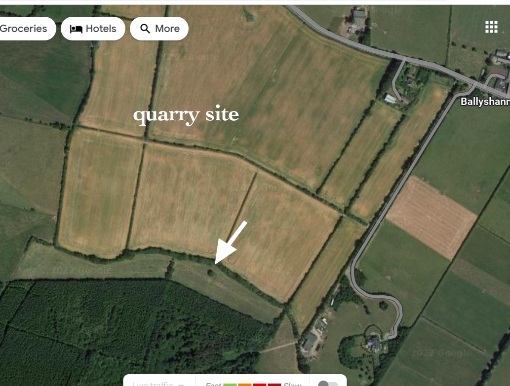
Large Hawthorn Tree [Crataegus monogyna]on the boundary of proposed quarry site (fairy tree). Google Map ref: https://bit.ly/3lzTYXi
|
|
2 |
Ballyshannon, Kicullen |
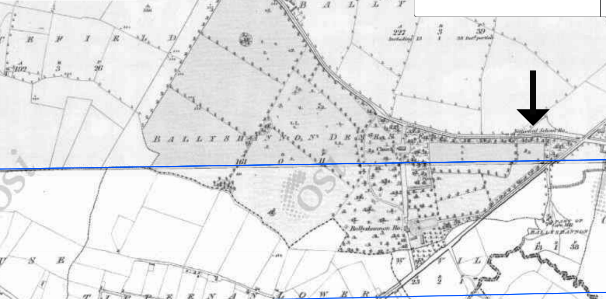
Large beech trees [Fagus sylvatica] lining part of the L8006 – L8007 (the quarry road site) stand the last remaining trees of Ballyshannon Demense, the old Estate House see below Map. Google Ref: https://bit.ly/3wHqED5
|
|
3 |
Kildoon Wood
|
This is a rare tract of residual woodland park of Kildoon Bog and should have been protected long ago. Google Ref: |
|
4 |
Eaglehill Woods |
Woods to the back of the Racefield site, the Eaglehill Stream flows through which is part of the Barrow Nore Sac. Google Ref: |
County Museum: It is noted that there are no museums in the County. This is a sad reflection on a self-proclaimed heritage county. It is therefore recommended that a policy be inserted seeking supporting the provision of a county museum.
Archaeology Planning Conditions: Archaeological conditions in many planning permissions are not actively enforced and need to be given far greater priority. Leaving it up to the developer to provide an archaeological report is foolhardy. In the past we witnessed a bogus report being submitted on foot of such a condition and merely paying lip service to one such condition.
It would be preferable that a policy specifically specifying that statutory authorities themselves would carry out such investigations at the expense of a developer. This would be far more credible and less open to abuse.
- The landscape continues to be blighted by the extractive industry (Quarries).
It should be noted that aggregates are finite in nature. In the space of a couple of generations, we have as a nation exhausted much of the residual resources of sand and gravel. In many parts of the world this is now a very scares commodity and dredging of estuaries is now commonplace with our neighbors in the United Kingdom where a tax on aggregates has even been imposed to conserve what little reserves are left. Moreover it is essential that many features within the landscape such as eskers and drumlins should be conserved. It should be borne in mind that modern quarry developments of the 2020’s are very different to the developments of the 1920’s or even the 1960’s when aggregates were originally removed in very small quantities by way of Horse and Cart and later by modest trucks. Nowadays, large multi axial and articulate trucks are commonplace in the quarry sector. These are capable of removing very large quantities of material in any given day or week. Having regard to the finite nature of aggregates therefore, it is recommended this and other applications be subjected to the utmost of scrutiny.
Has an audit of sand and gravel deposits been conducted in this and other counties? If not, it is recommended that this be conducted and the information used to more properly inform on any decision.
Has an audit of aggregates (limestone rock) reserves been conducted in this and other counties? If not, it is recommended that this be conducted and the information used to more properly inform on any decision.
Has a full SEA (Strategic Environmental Assessment) analysis been conducted? The SEA Directive provides that Programs / Plans / Projects should be conducted as a whole and not in isolation. Therefore it is essential that all related extractive applications in this and other counties be examined as part of the broader mix. Has Directive 2001/42/EC been complied with?
Has a Natura Impact Assessment / Appropriate Assessment being submitted with this application? If not, please address this issue. Conversely, if one has been submitted, please establish its adequacy and whether this application in compliance with EU Directives including Directive 92/43/EEC?
Please establish whether the proposal compatible with the European Landscape Convention? The UK and Ireland ratified the convention and it became binding on 1st March 2007.
Security lighting has become a major issue with nighttime lighting being completely unacceptable. There are numerous instances of excessive nighttime lighting by this and other operators. Dark sky’s are essential for a vibrant nighttime habitat. In fact it is difficult to reconcile the applicants language for ‘beneficial agricultural and ecological after-uses’ with their penchant for erecting inappropriate LED type lighting around many of its other operations.
Note that truck movements give rise to considerable nuisance for a local community. Large numbers of trucks from a busy quarry make walking or cycling all but impossible while local motorists find trucks to be very challenging on narrow country roads. They are also very difficult to drive behind in wet conditions as they throw up a lot of dirty water. Moreover the roads become coated in a film of dust, which manifests itself in the form of dirty cars in the winter months, and dust in the summer months. Fugitive dust continues to be problematic for neighbors of these types of developments.
Furthermore, monitoring has been left up to the operators of quarries in a form of self-policing. This has proved to be most unsatisfactory. It is imperative that all monitoring be conducted by statutory agencies.
Build to Rent and Shared Accommodation
Shared Accommodation: it is submitted that a ban be placed on all planning applications for shared accommodation schemes. Shared accommodation is socially undesirable and is unsuited to Ireland. Any references in the county development plan to shared accommodation should therefore be removed. (This is in line with our submission on this very issue re Chapter 3 – Settlement & Housing Strategy)
Roll-Down Shutter Blinds: We have in the past read critical comment about roll-down security screens. What on earth is wrong with a business wanting to protect their premises in an age of increasing crime? Any policy on this issue should be deleted; it’s daft.
Public Art at industrial/ warehousing, etc: We have examined other county development plans and read the following statement from the Meath County Development Plan 2021: DM OBJ 119; which states: ‘To require that all significant Industrial, Office, Warehousing and Business Park Development incorporate works of public art in the form of outdoor sculptures, special architectural and landscape features or other appropriate art work in the development.’ More daftness. If there are similar references in the current draft plan; they should be deleted too.
VIEWS AND PROSPECTS
Appendix 10 contains a list of Protected Views and Prospects.
South Kildare is poorly represented in the table of protected views and a list of additions is proposed hereunder. Furthermore, the protected views are poorly described with reference only to local names and with no reference to road grid references or the new GPS signage currently being rolled out. It would be helpful if such views should be referenced using such scientific criterion where possible. We had gone to the trouble of providing a list of views and prospects for the strategic issues paper and are surprised that this appears to have been overlooked or worse still ignored. In addition to the list in the draft plan, it is submitted that the following views be added: -
|
View |
Location |
Description |
Significance |
|
1 |
Dún Ailinne (a royal site), |
Ancient Ceremonial Site of Gaelic Ireland where Royal Kings of Leinster are Inaugurated
|
National |
|
2 |
The Curragh |
One of the oldest semi-natural grasslands in Europe. Used as a meeting site during Pre- Chrisitian Societies
|
Regional |
|
3 |
The hill of Allen |
Seat of ancient Hunter Warrior Fionn Mac Cumhaill. Used as a training ground for his warriors.
|
Regional |
|
4 |
Rath of Mullamast |
Daniel O’ Connell’s largest ever meeting, 1 million people expected. Historic point as it was the site of a previous british massacere of the Irish view of south Kildare, on to Laois Carlow.
https://en.wikipedia.org/wiki/Mullaghmast
|
|
|
5 |
Old Kilcullen Tower |
Monastry founded by St. Patrick in 5th Century raided by Vikings and built tower in 9th Century. Views of all East Kildare & Wicklow. Close to Dun Ailinne
|
|
|
6 |
Dunmurry Hill Rathangan |
Called the “ Chair of Kildare” is adjacent to Hill of Allen. Views of Kildare & Offaly
https://mountainviews.ie/summit/1244/
|
|
|
7 |
Brewel Hill |
Links to Cuachaillin View of South Kildare and Wicklow
https://visionsofthepastblog.com/2014/05/07/brewel-hill-stone-circle-co-kildare/ |
|
Archaeological Heritage
- A list of National Monuments and Registered Historic Monuments are contained in the Appendix. Archaeological structures may, in some situations, also be considered as architectural heritage and therefore may appear on both the Record of Monuments and Places (RMP) and the Record of Protected Structures (RPS). The below sites are recommended for inclusion. We were unable to find the below sites on the list. They should of course be included on the next development plan.
Appendix 6 Record of Protected Structures
|
Site Name |
Site Code |
|
Rath of Mullamast |
|
|
Largest recorded Meeting with Daniel O’ Connell |
|
|
No record of any Archaelogical digs that we are aware of. Archaelogical surevey should be as the are is of significant historical signifcance and a site of a previous massacere by the British ,hence why daniel O’ Connell choose the site. https://en.wikipedia.org/wiki/Mullaghmast Location: https://maps.app.goo.gl/oshgfapkJzz5BzCT6
|
|
|
Site Name |
|
|
Dun Ailinne, KIlcullen |
|
|
Ancient Ceremonial Site of Gaelic Ireland where Royal Kings of Lenster are Innaugarated |
|