
Tuairim
Chapter 1: Introduction and Strategic Context
I especially note the Strategic Vision of this Development Plan:
Strategic Vision: To build on the strengths of the county in order to improve the quality of life of all residents, through the creation of high-quality job opportunities, by the provision of high-quality residential development supported by adequate community infrastructure, through the provision of a high-quality sustainable transport network, by healthy placemaking and transformational regeneration, by supporting the transition to a low carbon climate resilient environment, by embracing inclusiveness and by enhancing our natural and built environment for future generations.
- Please note that both Dáil Éireann and Kildare County Council declared a Biodiversity crisis in 2019. The wording “enhancing our natural environment” is a very subjective statement. An explicit statement of intent to conserve and protect Kildare’s native habitats and species should be acknowledged in the strategic vision of this Development Plan.
1.4 Policy Context
I note the following:
A development plan shall, as far as practicable, be consistent with the Planning and Development Act 2000 (as amended), national plans, policies and strategies which relate to the proper planning and sustainable development of land.
- Can Kildare County Council outline how “as far as is practicable” is defined and what criteria will be used to ascertain what is practicable?
- Should the Climate Act and forthcoming Carbon budgets be referenced here?
1.4.1 Contents of Development Plans: Planning and Development Act 2000 (as amended)
I note the following and suggest revision as follows:
- Existing text: Promotion of compliance with environmental standards and objectives established for bodies of surface waters and groundwater.
- Suggested revision: Promotion of compliance Compliance with environmental standards and objectives established for bodies of surface waters and groundwater.
1.5 Climate Change
- Can the plan reference the forthcoming Kildare Climate Action Plan here, and outline how the CDP will include this on its completion?
1.6 Sustainable Development Goals
- Can more detail be provided on where the UN Sustainable Development Goals (SDGs) align with the National Planning Framework’s National Strategic Outcomes (NSOs), and what measurable metrics KCC will use to measure SDG progress as part of the CDP delivery?
-
How will the plan ensure that SDGs are applied through the lens of the climate and biodiversity crises, and that SDG8 (Decent Work and Economic Growth) will not be prioritised over others.
Chapter 2: Core Strategy and Settlement Strategy
2.1 Overall Aim:
I suggest insertion of the following:
To provide for the delivery of an additional 9,144 housing units to accommodate an additional 25,146 people by the end of the Plan period, through the delivery of sustainable, compact settlements supported by a commensurate level of physical, social and green infrastructure to mitigate against climate change.
2.5.1. Kildare’s Population Growth Trends:
No further comment here except to draw attention to Kildare’s Population Growth Trends:
In relation to ‘approximately 72% of the county’s population live on 5% of the county’s total land area, with the northeast of the county having by far the highest population densities.’
- This further reinforces the importance of maintaining open spaces in Kildare for human wellbeing and as a counterbalance to development and habitation pressures on nature and on our environment.
-
- Compact Growth and Climate Action
- Can the Development Plan outline how the embodied carbon of new planned developments been accounted for and how steps will be taken to reduce the impact of emission from new developments?
- How will the plan ensure a ‘climate and biodiversity first’ lens to planning decisions?
For example:
-
- Mandating the use of more sustainable building materials.
- Promoting the redevelopment of brownfield and derelict sites ahead of greenfield sites.
- Mandating a percentage C&D waste recovery on sites.
2.7 Town and Village Renewal
- How will derelict properties play a role in Town and Village Renewal and contribute to growth outcomes?
- Can the CDP state a preference for bringing derelict sites back into use ahead of building new developments?
Table 2.8 – Settlement Hierarchy Population and Housing Unit Targets Q1-2023 to Q2-2028
In Table 2.8, the projected Kildare population for 2021 is 235,387 (an increase of 5.75 % on 2016 census figures). It then appears that this percentage increase is blanketly applied across all towns.
-
What is the rationale for this? For example, see the following:
- Eastern & Midland Regional Assembly Regional Spatial & Economic Strategy 2019-2031.(https://emra.ie/dubh/wp-content/uploads/2020/05/EMRA_RSES_1.4.5web.p)
- “Towns recording the highest growth rates in the country over the last ten years (>32%), and which have lower levels of employment provision include; Ashbourne, Balbriggan, Blessington, Clane, Kinsealy-Drinan, Lusk, Laytown-Bettystown, Ratoath, and Sallins.”
and
- Housing Need and Demand Assessment (HNDA) & Housing Strategy (https://consult.kildarecoco.ie/sites/default/files/FINAL%20Appendix%201%20HNDA.pdf)
- “At Electoral Division level, between 2006 and 2016, only 6 of the 89 EDs in Kildare witnessed population decline– most notable of these has been the decrease in Newbridge Urban by -2.6% (-206) - in sharp contrast to the high growth in the town’s environs. As represented on the map in Figure 3, highest increases have all been in the environs of urban areas and in general the central and northeast of the county, with the majority of this growth taking place between 2000 and 2011, influenced primarily by growth designations under the 1999 Strategic Planning Guidelines for the Greater Dublin Area, extensive residential zoning of land and celtic tiger era construction levels. Increases in excess of 45% were recorded in the EDs of Newbridge Rural (+46.3%), Donaghcumper (+46.5%), Kilcock (+47.5%), Athy Rural (+53.1%), Naas Rural (+59.3%), Rathangan (+68.5%) and Newtown (+95%).”
2.11 Rural Settlements in the Countryside
I note the following:
There is continued and considerable development pressure for single homes in the rural area across County Kildare from
Additionally, I note that during the period 2016 to end of year 2020, the number of residential units in County Kildare increased by 6,176, of which rural one-off houses (892) accounted for 14.4% (averaging to 178 houses per annum). And in 2020, 162 permitted dwellings were rural one-off houses.
- Housing Need and Demand Assessment & Housing Strategy
- https://consult.kildarecoco.ie/sites/default/files/FINAL%20Appendix%201%20HNDA.pdf
and that:
“The Kildare County Council internal planning application operating system does not have the facility to filter down to a level which differentiates between urban one-off and rural one-off houses. This deficiency has been flagged with the development management team as an item for potential upgrade in the future.”
- Housing Need and Demand Assessment & Housing Strategy
- https://consult.kildarecoco.ie/sites/default/files/FINAL%20Appendix%201%20HNDA.pdf
I also note National Policy Objective 20 and the requirement to:
“Project the need for single housing in the countryside through the local authority’s overall Housing Need Demand Assessment (HNDA) tool and county development plan core strategy processes.”
Project Ireland 2040 National Planning Framework
https://npf.ie/wp-content/uploads/Project-Ireland-2040-NPF.pdf
As Chapter 2 makes no specific reference to the Kildare HNDA tool, I feel that this should be addressed in this chapter in the interest of clarity.
-
Has the Housing Need Demand Assessment (HNDA) tool been developed for Kildare?
- If not, then a specific action needs to be stated.
- What is the projected need for single housing in the countryside?
- How do the number of units in Table 2.8 – 137 (Rural Settlement), 732 (Rural Dwellers), 92 (Blessington Environs) break down to single housing stock?
2.14 Employment in Kildare
- Will planning decisions that enhance local employment be screened for biodiversity and climate impacts? For example, should a distribution depot be built in Kildare, how is the impact of the increased necessary logistics accounted for?
- What measures are being taken to attract climate positive employment in the county?
- What criteria are being used?
Core Strategy and Settlement Strategy Objectives
I note the 18 Core Strategy objectives outlined at the end of this chapter and stakeholder involvement/responsibility listed in Appendix 12.
While I welcome a number of inclusions in these objectives, and particularly those objectives that are linked with adapting to and mitigating against the impacts of Climate Change, I am extremely concerned that the Biodiversity Crisis has not been acknowledged in these core objectives.
Additionally, I note that aside from the 18 Cores Strategy objectives, there are 1930 additional objectives of the Development Plan. Of these 1930 additional objectives:
- The National Park and Wildlife Service (NPWS) is only listed once as a stakeholder and
- Planning (Heritage) is listed only 13 times.
- Please refer to our further comments on Chapter 16 Monitoring and Implementation.
The first objective of the current National Biodiversity Action Plan 2017-2021 is to mainstream biodiversity into decision-making across all sectors. Under this objective, the following is stated:
“Under this Plan further action will be taken to raise awareness within the public sector of the implications of policy and decisions on biodiversity, through for example, the articulation of no net loss biodiversity targets in plans/policies and the appropriate utilisation of ecological expertise”. (https://www.npws.ie/sites/default/files/publications/pdf/National%20Biodiversity%20Action%20Plan%20English.pdf)
In February 2020, the Interim Review of the Implementation of the National Biodiversity Action Plan 2017-2021 published its findings.
(https://www.npws.ie/sites/default/files/publications/pdf/Interim%20Review%20of%20the%20Implementation%20of%20the%20National%20Biodiversity%20Action%20Plan%202017%20-%202021%20.pdf)
The audit of that report by the National Biodiversity forum states that mainstreaming is “wholly insufficient for the scale of the challenge” and that
“Ireland lags behind its neighbours in incorporating biodiversity into the planning process. Investment in Biodiversity Officers across all local planning authorities is vital, and the Government must consider requiring plans and projects to achieve Biodiversity Net Gain, not just No Net Loss.” (https://www.biodiversityimpactplan.ie/1-governance)
Additionally, Ireland’s 6th National Report to the UN Convention on Biological Diversity (2019) called for a transformational change to conserve and restore biodiversity nationally and at EU and a global level. (https://www.npws.ie/news/ireland%E2%80%99s-6th-national-report-un-convention-biological-diversity-released#:~:text=The%206th%20National%20Report%20reviews,is%20at%20an%20insufficient%20rate)
I urgently call on Kildare County Council to be part of the transformational change necessary to halt any further degradation of Kildare’s habitats and dependant species and to begin meaningful action on restoring Kildare’s habits for future generations and to take account of the following considerations:
- Resourcing: As part of this transformational change, it would be inconceivable that a single person should be required to cover the huge remit of built and natural heritage, along with the increasing demands of liaising with other departments (Planning, Roads, Environmental Services etc.) on statutory obligations of Environmental Assessment and Appropriate assessment, along with the increasing necessity to liaise with relevant stakeholders in restoring degraded habitats to function in mitigating against Climate Change; when for example, planning and other departments have extensive staffing. This must be urgently addressed.
- Public Education: Additionally, if we are to be serious about engaging local communities in meaningful biodiversity actions, then this should be well informed action. At best ill-informed action is a waste of public funding and at its worst it may lead to harm (please refer to our comments on Chapter 12).
- Inventory of Protected Sites: Requisite to this is the need for a publicly accessible inventory of protected sites, high nature value sites and sites for protected flora and fauna in Kildare. It is important that these sites are distinguished and not lost under the poorly understood term “green infrastructure”. Along with helping to inform and educate local communities, this inventory will help to guide and inform Planning and other departments in decision making.
In light of the above, and continuing negative impacts on Kildare’s habitats and species, I respectfully insist that this necessitates that an additional objective is inserted into the Core Strategic Objectives
- Proposed Additional Objective: Ensure that the future growth and spatial development of County Kildare does not further undermine Kildare’s protected habitats and species. Engage with NPWS and other relevant stakeholders to urgently progress management plans for Natura 2000 sites and other protected sites in the County. Engage with all relevant stakeholders, including NPWS and national experts in flora and fauna, including the NGO sectors (for example, BSBI County Recorders) to identify and protect high nature value habitats and sites for threatened species in County Kildare. Tangibly commit to meaningfully tackling Biodiversity Loss in County Kildare by providing additional resources for the employment of an additional suitably qualified staff member dedicated to the conservation and protection of Kildare’s habitats and species, compiling an inventory of High Nature Value sites and protected species, community education and engagement on meaningful biodiversity actions, and ensuring that funding for biodiversity is directed to meaningful outcomes.
Additionally, I suggest an addition to CSO 1.13 as follows:
- CSO 1.13 - Engage with public infrastructure providers including Irish Water and local communities to provide serviced sites with appropriate infrastructure for people to build their own homes in designated towns and villages, subject to all relevant planning and environmental criteria as a sustainable alternative to one off housing. Develop Housing Need Demand Assessment (HNDA) tool for Kildare and project the need for single housing in the countryside by the end of 2023 in line with National Policy Objective 20, Planning Framework 2040
I also suggest an addition to CSO 1.17 as follows:
- CSO 1.17 - Continue to work with the educational institutions throughout the county and Solas, in order to further enhance the already existing highly skilled labour force in Kildare and to encourage improvements in the labour force to include the development of specific apprenticeships in the technology, renewable technologies and retrofitting apprenticeships, tourism, youth and childcare sectors during the lifetime of the plan to enhance and develop the agility of the workforces in those sectors.
CSO 1.18 in its current form does not translate to an impactful objective. I recommend this should be amended to:
- CSO 1.18 - To consider aligning Align the Kildare County Development Plan 2023-2029, with the up-to-date population from the forthcoming Census, where there are verified material population differentials to those in Table 2.8 of the Plan, by way of a statutory variation pursuant to Section 13 of the Planning and Development Act 2000 (as amended).
Chapter 3: Housing
3.2 Strategy
I note the following in this chapter’s strategy:
Engaging in active land management to promote regeneration including utilising the Vacant Sites Register and other future vehicles, including the Zoned Land Tax.
3.3. Policy Context
The following should be inserted to the list of policies governing this chapter:
- Sustainable Rural Housing Guidelines (2005)
- Derelict Sites Act, 1990 (as amended by the Planning and Development Act, 2000)
- Urban Regeneration and Housing Act 2015
3.9 Regeneration, Compact Growth and Densification
HO O13 - seeks to: Support and promote the renovation and re-use of obsolete, vacant and derelict homes through a number of means.
However, I note that no actions are listed under this section. There are currently six properties in County Kildare on the Vacant Sites Register. If this register was actively managed and the vacant site fee collected, these funds could be put to great use if invested in the communities affected.
Additionally, this would greatly encourage owners to develop these sites and revitalise town centres. There are many derelict sites in all of our towns in Kildare. This is an area where the council can exert great control. I recommend insertion of the following actions:
Additional Action 1: Develop a staged plan to populated and actively manage the Vacant Sites Register (VSR) over the lifetime of this plan.
Additional Action 2: Actively enforce the Urban Regeneration and Housing Act 2015 using the VSR.
Additional Action 3: Actively enforce the Derelict Sites Act, 1990 (as amended by the Planning and Development Act, 2000) using the VSR.
3.11.1 Older People
I commend the Council on all objectives HO O21 - HO 026
I feel that a similar actionable commitment as HO O42 should be made to integrate the Property Interest Register and Land Development Agency (LDA) maps, and to work in partnership with the LDA to identify state owned sites in urban centres to provide housing for older people, within walking distance of shops and services and public transport along the lines of McAuley Place, Naas.
HO O42 (Support and, where feasible, work in partnership with the Land Development Agency (LDA) in the provision of social and affordable housing in County Kildare)
Insert new objective, as follows:
Additional Objective: Integrate the Property Interest Register and, where feasible, work in partnership with the Land Development Agency (LDA) to target sites within walking distance of shops and services and public transport for the provision of housing for older people in County Kildare.
3.13. Sustainable Rural Housing
I particularly welcome many of the objectives in this chapter relating to Rural Housing. I submit the following:
HO 050 - Require that all applications demonstrate the ability to provide safe vehicular access to the site where the necessity to remove extensive stretches of native hedgerow and trees or can demonstrate existing hedgerow is not native and provide a landscape design to reinstate a hedgerow to outline proposals for replacement of same or comparative. Note; The need for the removal of extensive roadside hedgerow may indicate that the site is unsuitable for development.
- HO 050 does not seem to be grammatically correct and does not provide a clear meaning.
- I strongly suggest that any requirement to reinstate a hedgerow should in all cases stipulate that only native species of trees or shrubs of native origin and provenance be used:
- To protect the genetic integrity of our native island species (a component of the IUNC definition of biodiversity – see our comments on chapter 12), and to provide clear guidelines to planners and the general public (especially with regards to Technical consideration 4 “Planting for biodiversity”)
-
To reduce the risk of importation of pests and diseases, particularly microorganisms.
- See O’Hanlon et. al. 2021 Catalogue of Pests and Pathogens of Trees on the Island of Ireland. Biology and Environment: Proceedings of the Royal Irish Academy
- “In the last decade however, the greatest risk to trees and forests on the island of Ireland is the introduction of non-native pests and pathogens.”
-
To support local nursery stock businesses, see:
- See RE P13 (Chapter 4) Support and facilitate sustainable agriculture, horticulture, forestry and other rural enterprises at suitable locations in the County.
-
Implement the guidance of the Draft Kildare County Development Plan 2023-2029 - SEA Environmental Report:
- https://consult.kildarecoco.ie/en/system/files/materials/4060/Draft%20Kildare%20CDP-%20SEA%20Environmental%20Report%20Final%20Issue.pdf
- “Require that proposals retain and maintain existing hedgerows in all instances, with the exception only of the section required to be removed to provide visibility at the proposed site entrance. On such cases, proposals for replacement hedgerows, including details of composition and planting must be submitted with any application which requires such removal.”
Similarly, HO P29 should state native hedgerow species of native provenance and origin.
3.17 Flood Risk Management
I refer to:
Applicants will be required to comply with the requirements of The Planning System and Flood Risk Management Guidelines for Planning Authorities, DEHLG (2009) where appropriate and applicable.
- Do these requirements reflect current pluvial flooding forecasts for Kildare along a 1.5 OC trajectory? If not, how can they be improved?
Additional Comments
Taking account of the targets regarding student accommodation and rental properties, how does KCC plan to manage and incentivise domestic energy efficient measures to be taken in non-owner-occupied properties?
Chapter 4: Resilient Economy and Job Creation
4.10 Foreign Direct Investment
- Will future FDI investments be climate risk proofed to establish the likelihood of their existence in a climate transition?
- Will any climate criteria be established in planning decisions related to FDI investment?
4.11 Small-Medium Enterprises
- What are the criteria used to decide levels of SME supports? Does climate/biodiversity feature?
- How will LEO ensure sustainable enterprise development that does not widen the emissions gap?
4.16 Data Centres
In relation to the following:
RE O70 - Require data centres to consider the use of sustainable renewable sources of energy to fuel their operations in whole in the first instance or in part where this is not possible and where it has been satisfactorily demonstrated not to be possible.
- Clarify what criteria will be used to determine whether the use of sustainable renewable sources of energy is not possible?
- Data centre water usage concerns me hugely. I believe the CDP should include measures to reduce water usage and recycle the water used where possible.
4.17 Green / Circular Bio-economy
In the interests of clarity, I suggest rewording the title of this section to Green / Circular economy and Bio-economy. As the Green / Circular economy relates to more than just biological resources (e.g. fossil fuel and precious metal products).
Additionally, the word bio-based should be deleted from the third paragraph in this section, as all products, materials and resources should be maintained in the circular economy for as long as possible:
The transition to a more circular economy and bio-economy, where the value of bio- based products, materials and resources is maintained in the economy for as long as possible, and the generation of waste minimised, will provide an essential contribution to Kildare developing a sustainable, low carbon, resources efficient and competitive economy.
- Additionally, insert clarification of native trees of native origin and provenance in RE P12:
RE P12 Additional native tree planting of native origin and provenance and landscaping on existing and proposed enterprise zones and development sites to aid with carbon sequestration
- I welcome objectives RE O71-O80 but note that there are no specific actions detailed.
- Additionally, objective RE O83 is welcomed but lacks clarity and details no specific action.
RE O83 Maximise the ability of communities to be self-sufficient in food production, energy savings and production, waste disposal etc.
Section 4.21 Tourism
- How will the Country Development Plan mitigate against any induced demand for transport, and associated negative environmental impacts, as part of increased tourism in the area?
4.18 4.18 Agri-Food and Beverage Sector
I note the following objective:
RE O83 Maximise the ability of communities to be self-sufficient in food production, energy savings and production, waste disposal etc.
-
I suggest Linear to Circular Economy Hub pilots should be scaled up across the county, for example:
- The Bord na Móna HQ in Newbridge is an example of an Innovation Hub for employment and training in a shift from a Linear to Circular economy availing of AES Waste material to fuel future economies.
Section 4.24 Peatland Tourism
Amend all instances of National Peatlands Heritage Park to National Peatlands Park in this chapter – to provide consistency throughout the Development plan. For example:
- This has potential for tourism resources, examples of which could include,
peatways, bike-hire facilities recreational forestry, wilderness, eco-tourism based on biodiversity and a National Peatlands Heritage Park.
- in RE O126
- in RE O127
General Comments on Chapter 4
- While it is welcome to see efforts to develop the circular and bioeconomy in Kildare, what precautions will be taken to ensure mitigation against induced demand? For example, should a business be developed that is bult on the utilisation of what is a current waste material, how will KCC ensure that the further development of this business will not lead to further demand for the waste product?
- Objectives are set out to increase overall sustainable and climate enterprises throughout the county. However, it is not clear if this is in addition to traditional industries or with an aim to displace? Clear targets and criteria should be set.
- It is not clear what criteria is being used to define ‘sustainable’ when it comes to the different sectors mentioned in this chapter. Does this mean jobs? Will there be a higher weighting given to climate and biodiversity criteria versus traditional economic criteria which does not reflect the current crises or planetary limits?
- How will new employment opportunities be climate proofed? e.g. logistics is mentioned as an opportunity area. How does KCC plan to support the implementation of carbon budgets while also growing industries contributing to higher emissions?
- Can an objective be included to mandate new and existing employers to set out sustainable travel policies for employees?
Chapter 5: Sustainable Mobility and Transport
The CDP refers to: A sustainable transport system is one that is accessible, safe, environmentally- friendly, and affordable. (ECMT 2004) This definition indicates the need for a balance between social, economic, and environmental goals, policies and objectives.
As we are in the midst of a climate and biodiversity crisis, I recommend the CDP moves away from quoting the ‘Triple Bottom Line’ approach and moves towards a ‘Doughnut Economics’ approach that recognises that the planet does not depend on the economy, however the economy is completely dependent on the natural world. (See: Doughnut Economics: https://doughnuteconomics.org/about-doughnut-economics)
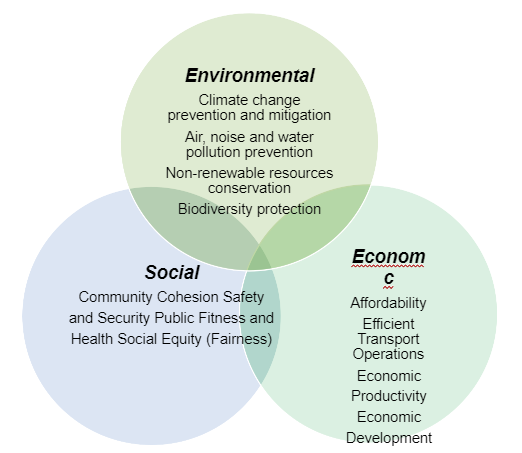
Figure 2 Trible Bottom Line
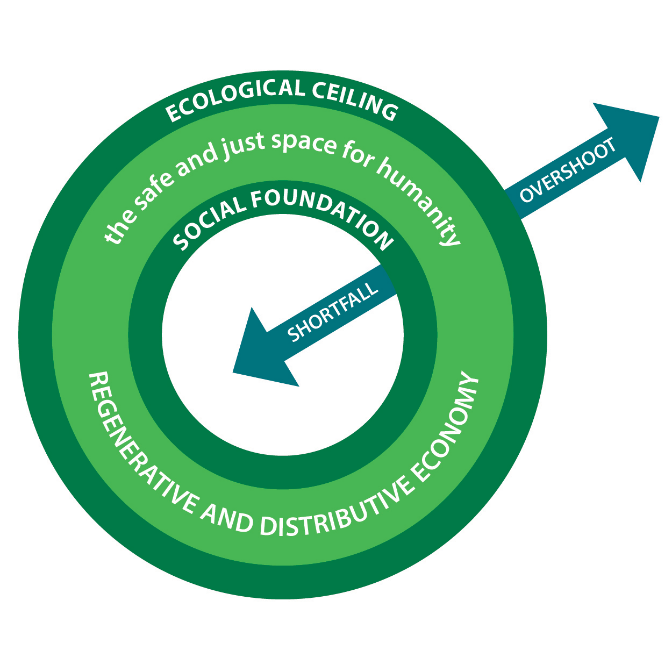
Figure 3 Doughnut Economics
In contrast to agriculture and energy, transport is the area where a local authority can have the greatest impact on climate change. I welcome the support for sustainable transport including walking and cycling and the lesser role envisaged for car-based travel. However, I consider that the County Development Plan should explicitly state that a significant reduction in car use is an essential requirement for a sustainable future. Transport Infrastructure Ireland (TII) design requirements specify that planners design for increased number of vehicles in the future which is incompatible with decarbonising of transport and avoiding climate change.
I strongly support the concept of a 10 minute settlement although the distance covered by a 10 minutes journey by foot, by bicycle and by public transport varies significantly. Kildare towns and villages are relatively small by international standards with none having dedicated local public transport. Active travel is feasible if made attractive to people who drive their cars for short journeys.
I support the recognition that traffic congestion is reduced by more active travel rather than the traditional solution of more roads and more road space.
I welcome the (January 2029) targets for modal change. However, the targets should be broken down into individual urban areas and for rural areas county wide. Following on from the County Development Plan, the targets should also propose 2030 targets which is a key date for Ireland’s international commitment on climate action. Targets which involve a change in travel mode from private cars should also be quoted in terms of number of commuting vehicles so that Kildare’s impact on the Climate Action Plan commitment of 51% reduction in fossil fuelled vehicles can be quantified.
It is disappointing that many of the objectives and policies refer to promotion and feasibility. The plan would be more progressive and definitive if it referred to achieving and/or enabling. In particular, the statement:
Kildare County Council will endeavour to deliver a reduction in private car usage broadly in line with the 51% reduction in emissions by the end of this decade …
- lacks ambition and recognition of the seriousness of climate action.
5.3 Overarching Goals, Policies and Objectives
I commend the CDP in referring to the prioritisation of walking, cycling and public transport in policy statement TM P1.
TM P1 - Promote sustainable development through facilitating movement to, from, and within the County that is accessible to all and prioritises walking, cycling and public transport.
- Will an action be included to set out to the criteria, and how it will be applied, to ensure this prioritisation occurs?
I note the following objectives and actions and suggest insertions and amendments, as outlined here:
TM O6 - Support and encourage Require employers to develop and implement Workplace Travel Plans which deliver modal change based on the NTA’s Workplace Travel Plans: A Guide for Implementers (2013).
TM O7 - Introduce measures to reduce traffic congestion in town centres such as pedestrianisation, pedestrian priority and/or improved pedestrian/cyclist facilities, in particular increasing the number of safe crossings.
In relation to car shedding and consideration of how to travel, three key moments are when people get a new job, buy a new house or have a new person in their household. In light of this, please insert an additional objective as follows:
Additional Objective - Encourage new employees, house buyers and parents to consider active and sustainable travel in conjunction with Kildare stakeholders.
5.4 Sustainable Movement
I note objective TM O11 here and suggest the following additional changes:
TM O11 - Investigate the feasibility of developing high-quality, suitable, safe and sustainable cycling pathways:
- from Leixlip, Maynooth and Naas into Dublin; and
- between Naas and Newbridge,
- Kildare town to Newbridge and westwards towards Portlaoise as far as the Kildare county boundary, and
- Kildare Town to Monasterevin.
- Enfield to Edenderry disused railway line.
- Along a Kildare section of the Trans-European Transport Network (TEN-T).
- Additionally, how is ‘feasibility’ defined?
- Can trialling be included as part of these feasibility studies to ensure time is not lost on reports?
5.4.1 Walking and Cycling
I note the following objectives and suggest insertions and amendments, as outlined here:
TM O16 - Ensure regular maintenance, including winter maintenance, of walking and cycling routes and ensure that all roads in new developments are designed in accordance with the principles, approaches and standards contained in the Design Manual for Urban Roads and Streets 2019, the National Cycle Manual (NTA, 2011 – or the pending update) and the Draft GDA Cycle Network Plan (NTA, 2021).
TM O19 - Investigate the feasibility of dedicating Dedicate a street(s) to pedestrian only activity on certain days of the week or at certain times of the day, in a pilot town, in each municipal district, during the life of this Plan.
TM O32 - Promote and encourage Support the use of the Toolkit for School Travel (2019) by teachers, parents and others and promote and encourage, in consultation with the Department of Education, substantial changes in relation to the items that learners are expected to bring to and from school daily to encourage more learners to cycle to school
TM A7 - Investigate the feasibility of providing a footpath connection dedicated shared path from Maynooth to Celbridge.
TM A13 - Prepare a Cycle Network Study for each of the key towns in County Kildare consisting of the primary links identified in the NTA’s Draft Greater Dublin Area Cycle Network Plan (2021), connections between the major towns and surrounding settlements, key strategic cycle routes, greenways and local links, all in accordance with the National Cycle Manual. The study will include draft widths, level of services and identify local targets.
Revised TM A13 - Prepare a Cycle Strategy for each of the key towns in County Kildare consisting of the primary links identified in the NTA’s Draft Greater Dublin Area Cycle Network Plan (2021), local links and links to surrounding settlements; include key strategic cycle routes, greenways connecting the major towns, all in accordance with the National Cycle Manual. The study will include draft widths, levels of service and identify local targets.
TM A16 - Provide new or upgraded dynamic lighting for all footpath and cycle track schemes subject to the consideration of ecology and impacts on wildlife. Appropriate environmental assessments will be required and may result in unlit sections which may include some parts of the county’s Greenways.
Additionally, please insert additional action, as follows:
Additional Action - Design separate facilities for pedestrians, cyclists and vehicle drivers unless vehicle speeds and levels of activity are low. If numbers are high, shared space will result in a poor level of service for all.
5.5 Road and Street Network
I note objective TM O58 the following amendment:
TM O58 - Secure the implementation and maintain corridors free from development to facilitate future roads, cycle facilities and other transport infrastructure improvement identified within this Plan (Tables 5.4 & 5.5) and Local Area Plans. The further progression of the road projects is subject to assessment against the National Investment Framework for Transport in Ireland (NIFTI) ‘Principles of Road Development’ criteria set out in Section 13.2 of the Draft Transport Strategy for the Greater Dublin Area 2022-2042. Where the road project is an orbital road around a town centre, the development must be accompanied by enhanced public transport, cycling and pedestrian facilities in the relevant centre, as required by Section 13.5 o
5.6 Motorways
Delete this objective TMO71 as it is incompatible with government Climate Change objectives.
TM O71 - Support and facilitate enhanced orbital movement between the N3, the N4 and N7 national roads, by the widening of existing roads and/or the development of new road links, for the purpose of providing resilience to the operation of the M50 and incorporating provision for sustainable transport as provided for in the NTAs Draft Transport Strategy for the Greater Dublin Area 2022-2042 and the Regional Spatial and Economic Strategy
5.8 Regional Roads
In relation to TM O85, please note Table 5.5 includes 44 regional roads (virtually every regional road in the county). This is in addition to some 20 priority road projects listed in Table 5.4 (Section 5.1 Roads and Street Network).
TM O85 - Progress the regional roads identified for improvement as set out in Table 5.5 subject to funding. During the life of this Plan, select a (section of) regional road linking two urban settlements in each of the municipal districts and investigate the feasibility of providing a segregated shared path adjoining it.
5.10 Road and Street Design
I note objective TM O98 and suggest the following amendments:
TM O98 - Set and apply speed limits taking into account the function of the road or street, the characteristics of the surrounding area, the design of the street environment and the presence of potential vulnerable users. The speed limits shall be in accordance with the Road Traffic Act 2004 (as amended) and shall be subject to the requirements of the Guidelines for Setting and Managing Speed Limits in Ireland (2015) in accordance with the Stockholm Declaration.
Please insert Additional Action, as follows:
Additional Objective - Reduce motorised traffic in town centres where alternative routes exist so as to promote walking and cycling in the interests of road safety.
5.12 Car Parking
I note objective TM O107 and suggest the following amendment:
TM O107 - Seek to reduce Reduce the level of on-street parking with a view to the reallocation of the roadspace to sustainable modes and to investigate the feasibility of delivering parking on suitable backland sites that would not jeopardise the vitality and vibrancy of the relevant town/village centre.
Targets
TM T1 - As a minimum, reduce the current car-based trips to work from 74% to 50% and the car-based trips to education from 50% to 40% by the end of this Plan period.
- This target is underwhelming given the scale of the crisis. If a 2:1 approach is to be taken as per Government plans, the targets, at a minimum should be:
- As a minimum, reduce the current car-based trips to work from 74% to 33.3% and the car-based trips to education from 50% to 33.3% by the end of this Plan period.
In response to the below targets:
- TM T2 - As a minimum, increase the current modal shares of trips to work by walking to 20% and cycling to 10% during the lifetime of this Plan and
- TM T3 - As a minimum, increase the current modal shares of trips to education by walking to 50% and cycling to 15% during the lifetime of this Plan.
- TM T4 - As a minimum, increase the current modal shares of work trips by bus to 13% and train to 14% during the lifetime of this Plan.
These targets are hugely underwhelming given the scale of the crisis. If a 2:1 approach is to be taken as per Government plans, the targets should collectively be aiming for walking and cycling to make up at least 66% of all trips to both work and education.
Chapter 6: Infrastructure and Environmental Services
6.1 Background
generally classified as being of poor or good status. Poulaphouca Reservoir is located within the Liffey catchment and partially in County Kildare. This lake is the only lake in Kildare attributed with a status (it is identified as being of moderate status). Downstream of County Kildare, the Liffey catchment includes various bathing waters at Dublin Bay. The north-eastern corner of the County forms part of the Boyne catchment – waters here are generally classified as being of poor or moderate status.”
With respect to water quality, I note policies IN P1 and in particular IN P2:
IN P2 - Ensure the protection and enhancement of water quality throughout Kildare in accordance with the EU WFD and facilitate the implementation of the associated programme of measures in the River Basin Management Plan 2018-2021 (and subsequent updates).
Additionally, I note objectives IN O1 - IN O11 and particularly IN O5 and suggest amendment as follows:
IN O5 - Manage, protect, and enhance surface water and groundwater quality to meet the requirements of the EU Water Framework Directive to achieve good ecological status by, at the latest 2027.
- However, I note that no recognition is given to the importance of peatlands in filtering water within river catchment areas, and contributing to the good ecological status of those waterbodies, and I recommend inserting the following objective:
- Additional objective - Recognise the important role of natural boglands and other wetland areas in filtering water and contributing to sound ecological status in river catchment areas.
Additionally, given the current ecological status of Kildare’s waterbodies (see Section 6.8.2 below) I am extremely concerned that only one single action – IN A1 - is listed in this section.
IN A1 - Install public water fountains in two towns as pilot schemes within 1 year of the adoption of this Plan.
I recommend inserting additional actions, as follows:
- Additional Action: Urgently seek adoption of the Southeastern River Basin Management Plan in cooperation with other relevant Local Authorities and stakeholders
- Additional Action: Enforcement and reporting of the Nitrates Regulations within all of Kildare’s River catchment areas in line with statutory requirements. (https://www.gov.ie/en/publication/b87ad-nitrates-directive/)
6.6 Surface Water / Drainage
I recognise the value and need for Sustainable Urban Drainage systems (SuDs); however, I would like to emphasize the following:
- The primary nature-based solution should be to leave established native vegetation in-situ, wherever possible, to intercept runoff.
-
It is important to note that SuDs have the capacity to disrupt and undermine the integrity of native flora when generic (often imported) swale, pond and other green infrastructure plants or seed mixtures are employed. Often planting specifications provided by landscape consultants are from generic lists of swale ‘wildflower’ mixes, or pond plants, and these plant mixtures bear little or no resemblance to natural pond floras or the flora of the surrounding area.
- https://dnfc.net/wildflower-seed-mixtures/
- https://pollinators.ie/wildflower-seed/expert-opinions/
- Additionally, aquatic plants are some of the world’s most problematic invasive organisms, many are extremely difficult to identify accurately to species level (relevant botanical expertise is required), and mis-identified invasive species are often sold in garden centres and nurseries, due to this difficulty.
- Aquatic plants are highly vagile and disperse readily in nature; therefore, left unplanted, pond features will rapidly colonise from locally available material and this should be the preferred option.
- Any nature-based or green infrastructure solution should therefore be under the explicit guidance of a suitably experienced botanist/ecologist. See: (https://www.susdrain.org/files/resources/other-guidance/ecological_benefits_summary.pdf)
In particular, I note the following objective:
IN O25 - Promote the use of green infrastructure (e.g., green roofs, green walls, planting, and green spaces) as natural water retention measures.
And I suggest that an additional objective should be inserted, as follows:
- Additional Objective - Require that established native vegetation should be left in-situ, wherever possible, to intercept, slow down and filter runoff as an integral part of all new development proposals.
Additionally, if we are to be serious and genuine about protecting our native biodiversity, I strongly suggest insertion of the following action:
- Additional Action - It is an action of the council to ensure that the construction of swales, ponds and other SUDS or nature-based solutions will not contribute to further native biodiversity loss, by requiring that plans submitted at design stage are under the direction of a suitably experienced botanist/ecologist. Additionally, the preferred option in employing these techniques is to allow natural recolonization, or at the very minimum, that any plantings arise from locally sourced native material of native provenance and origin.
6.7 Flood Risk Management
I particularly welcome insertion of objective IN O32.
IN O32 - Recognise the important role of natural boglands and other wetland areas in flooding patterns. Development in these areas shall therefore be subject to a Flood Risk Assessment in accordance with the relevant guidelines.
6.8.1. Waste Management
The most recent statistics from the EPA report that Ireland produced over 1 million tonnes of packaging waste in 2019, for the third year in a row; and of the 1,127,917 tonnes of packaging waste generated in Ireland in 2019, just 182,321 tonnes (16%) was recycled in Ireland.
It is unsustainable to continue to encourage the proliferation of packaging waste, particularly single-use packaging waste.
I strongly suggest the following change to objective - IN O42:
- IN O42 - Promote and facilitate communities to become involved in environmental awareness activities and community-based recycling initiatives reduction initiatives, which lead to local sustainable waste management practices.
In light of the EPA statistics above, the projected increase in population in Kildare, expiry of the Eastern-Midlands Regional Waste Management Plan 2015, publication of the more recent Climate Act, associated fossil fuel usage and CO2 emissions in the production and disposal of packaging waste, production of methane from food waste, current dire litter problems; I find the following action underwhelming:
IN A5 - Achieve the vision of the Eastern-Midlands Regional Waste Management Plan 2015-2021 by meeting the following targets:
- Ensure a 1% reduction per annum in the quantity of household waste generated per capita over the period of the Plan.
- Support the target to achieve a recycling rate of 50% of Managed Municipal Waste.
- Reduce to 0% the direct disposal of unprocessed residual municipal waste to landfill over the lifetime of this plan.
I suggest that a substantial revision of this commitment is required.
6.8.2 Pollution Control – Water, Air, Noise and Light
Water quality
I note the reporting of EPA’s Water quality in Ireland Report 2013 – 2018 in the introduction to this section; however, I would like to draw attention to the two maps produced in Figures A7 (Water Framework Directive (WFD) Quality Status 2010-2015 for Rivers and Lakes within County Kildare) and A8 (WFD Risk Status for Rivers and Lakes) of Appendix A of the Draft Kildare County Development Plan 2023-2029 - SEA Environmental Report: (https://consult.kildarecoco.ie/en/system/files/materials/4060/Draft%20Kildare%20CDP-%20SEA%20Environmental%20Report%20Final%20Issue.pdf)
The Water Framework Directive (WFD) Quality Status 2010-2015 for Rivers and Lakes within County Kildare are shown in Figure A7 of Appendix A, and the WFD Risk Status for Rivers and Lakes within the County is shown on Figure A8 of Appendix A. (Adapted from the Draft Kildare County Development Plan 2023-2029 - SEA Environmental Report: https://consult.kildarecoco.ie/en/system/files/materials/4060/Draft%20Kildare%20CDP-%20SEA%20Environmental%20Report%20Final%20Issue.pdf)
Additionally, I would like to direct the Council to the following from the EPA River catchment reports, and the relevant statistics pertaining to the number of waterbodies At Risk in both the River Barrow and River Boyne catchment areas, along with the most significant pressure: (https://www.catchments.ie/data/#/?_k=66otdi)
“A waterbody that is At Risk means that either the waterbody is currently not achieving its Water Framework Directive (WFD) environmental objective of Good or High Ecological Status or that there is an upward trend in nutrients or ammonia and if this trend continues the waterbody Status will decline by the end of Cycle 3 and will fail to meet its environmental objective”.
Barrow catchment area:
- 3rd Cycle Draft Barrow Catchment Report (HA 14) (https://catchments.ie/wp-content/files/catchmentassessments/14%20Barrow%20Catchment%20Summary%20WFD%20Cycle%203.pdf)
- In total there are 205 waterbodies in the Barrow Catchment and 96 (47%) are currently At Risk, 52 (25%) in Review and 57 (28%) are Not At Risk.
- The significant pressures affecting the greatest number of waterbodies is agriculture. Followed by hydromorphology, urban waste water, peat, urban run-off, domestic waste water, other, industry, forestry and mines and quarries.
- Agriculture is a significant pressure in 62 river waterbodies, five transitional waterbodies and five groundwater bodies. The issues related to farming in this catchment include diffuse phosphorus loss to surface water from, for example, direct discharges; or runoff from yards, roadways or other compacted surfaces, or runoff from poorly draining soils. High PIP for surface water nitrates was noted in arable and pasture lands, sediment is also a problem from land drainage works, bank erosion from animal access or stream
And the River Boyne catchment area:
3rd Cycle Draft Boyne Catchment Report (HA 07) (https://catchments.ie/wp-content/files/catchmentassessments/07%20Boyne%20Catchment%20Summary%20WFD%20Cycle%203.pdf)
- In total there are 172 waterbodies in the Boyne Catchment and 93 (54%) of these are currently At Risk, 32 (19%) in Review and 47 (27%) are Not At Risk
- The significant pressure affecting the greatest number of waterbodies is agriculture, followed by hydromorphological pressures, domestic waste water, peat, urban waste water, urban run-off, industry and mines & quarries.
- Agriculture is a significant pressure in 51 river waterbodies, five lake waterbodies, one transitional waterbody (Boyne Estuary) and six groundwater bodies in Cycle 3. Phosphorus loss to surface waters from, for example, direct discharges; or runoff from yards, roadways or other compacted surfaces, or runoff from poorly draining soils, remains an issue since Cycle 2. Sediment associated with agricultural activities, including land drainage works, bank erosion from animal access or stream crossings, has also been noted as an issue in this catchment. Organic pollution associated with run-off from farmyards in particular, has also been identified throughout the catchment.
I draw your attention to the following from Minister Darragh O'Brien (21.10.21): (https://www.oireachtas.ie/en/debates/question/2021-10-21/202/#pq-answers-202)
“Local authority functions, including enforcement activities, are set out under Part 6 of the European Union (Good Agricultural Practice for Protection of Waters) Regulations 2017. Under these regulations, local authorities are required to undertake inspections to determine on-farm compliance with the provisions of the regulations on farms within their jurisdiction.”
and the EPA: (https://www.epa.ie/publications/compliance--enforcement/public-authorities/EPA_LAEnforcementReport2019.pdf)
“Local authorities have substantial water enforcement related responsibilities to protect both human health and the environment. The work they do to delivery their key role in national water monitoring is fundamental to inform their action and the actions of other stakeholders. That being said, water quality is declining nationally, and there is a small number of enforcement actions and prosecutions being taken by local authorities. Local authorities and their shared service (the Local Authority Waters Programme) need to work together to deliver on their water quality protection functions. Local authorities also have a key role in protecting public health by monitoring and enforcing the drinking water standards in all regulated private water supplies.”
“Local authorities need to:
- Ensure the adequacy of their resources to meet their statutory water related responsibilities and increase enforcement action to protect both human health and the environment.
- Protect public health by monitoring and enforcing the drinking water standards in all regulated private water supplies.
- Maintain their key role in national water monitoring.”
“Local authorities need to:
- Ensure the adequacy of their resources to meet their statutory water responsibilities.
- Actively collaborate with their shared service to deliver their water quality protection and restoration functions. In particular where the local authority is advised of a significant decline in water quality under the Red Dot+ programme investigations should be undertaken.
- Maintain their key role in WFD monitoring, bathing water monitoring, and investigative monitoring
- Monitor all private water supplies and enforce the drinking water standards where monitoring identifies non-compliance to better protect human health.”
I note in the most recent EPA reporting cycle, 2019, that Kildare Co. Co. conducted 7 water inspections per 1,000 population (1,500 total water inspections), and that this is at the lower end of the scale, for example, Monaghan (19), Cavan (17), Mayo (17), Kilkenny (16), Sligo (14), Wexford (14), Kerry (13), Meath (12), Offaly (12), Laois (11), Roscommon (11) and Clare (10).
I note policy number IN P7 and objectives IN O52 and IN 053 in relation to water quality; however, given the significant pressure posed by agriculture to water quality I request that additional concrete actions be inserted.
IN P7 - Support the implementation of the Water Framework Directive, the River Basin Management Plan, and the Local Authority Waters Programme in achieving and maintaining at least good environmental status for all water bodies in the county.
IN O52 - Protect water quality from pollution by agricultural sources and to promote the use of good farming practices in accordance with the Nitrates Directive (91/676/EEC) and Ireland’s Nitrates Action Programme 2017- 2021 (including any subsequent update).
IN O53 - Assess applications for developments, having regard to the impact on the quality of surface waters and any targets and measures set out in the River Basin Management Plan and any subsequent local or regional plans.
Replace with:
- IN P7 - To actively implement the Water Framework Directive, the River Basin Management Plans, and the Local Authority Waters Programme and to attempt to achieve and maintain a high ecological status of all water bodies in the county by 2030. And at a minimum to achieve and maintain at least good ecological status for all water bodies in the county during the timeframe of this plan.
- Additional Objective: Ensure that adequate resources are in place to meet statutory water responsibilities
- Additional Action: Active enforcement and reporting of the Nitrates Regulations within all of Kildare’s River catchment areas in line with statutory requirements. https://www.gov.ie/en/publication/b87ad-nitrates-directive/
Additionally, I suggest inserting the following in IN O58:
IN O58 - Promote and support the ban on the use, marketing, sale, and distribution of bituminous coal and peat in Naas, Newbridge, Celbridge, Leixlip and Maynooth.
Chapter 7: Energy and Communications
7.5 Wind Energy
I note EC O11 and EC O16 suggest the following amendments:
EC 011 - Encourage wind energy developments in suitable locations in an environ- mentally sustainable manner whilst having regard to Government policy and the County Wind Energy Strategy.
Amendment: EC 011 - Consider wind energy developments in suitable locations in an environmentally sustainable manner whilst having regard to Government policy, the County Wind Energy Strategy and the EU and national target of 30% of land for biodiversity.
EC 016 - Require comprehensive winter and summer bird and wildlife surveys for all proposed wind farms sites, so that impacts on wildlife can be fully assessed and evaluated and so that appropriate mitigation and adaptation measures can be considered, to include for example removal or repositioning of turbines, introducing one black painted rotor blade (to reduce motion smear and reduce incident of collision) or the provision of technologies that help minimize harm to birds and other wildlife.
Amendment: EC 016 - Require comprehensive winter and summer bird and wildlife surveys for all proposed wind farms sites, as set out in EIA and other relevant legislation. Post- construction bird surveys should be included as a condition of planning for any consented developments to permit before and after impacts to be assessed. Turbine design and adaptation should use the best available technology to minimise harm to birds and other wildlife.
- Reason: While black-painted rotor blades may mitigate collision damage for some species and under some conditions there may be more effective devices available in the future. Wind farm developers should not rely on one mitigation factor alone that may not be effective for the sensitive target species (e.g. Curlew, Lapwing)
Additional comments:
It will be a time-critical missed opportunity if specific projects and plans are not identified locally to address climate mitigation measures.
Sustainable Energy Communities (SECs) are empowered communities at the centre of our sustainable energy transition and are best placed to drive these measures. I would like to see a specific commitment from KCC to collaborate with the SECs.
However, while each individual SEC will have their own unique projects, there will be a huge crossover of similar plans and projects which could be addressed as a network.
I propose the following to be researched and included in draft:
- Electric vehicles/bikes and charge points. The introduction of this type of transport will help in reducing emissions, alleviate traffic from heavily traffic areas and encourage people to get involved in alternative transport.
Lights:
- Any urban street, road and motorway lights to be switched off/or on sensors between midnight and 5 or 6am the following morning to prevent light pollution – no need to have lights, especially pedestrian lights on all night.
- The same measures to be taken for all public, state-owned and private commercial and industrial buildings & monuments which are unnecessarily lit up all night.
- Urban street lights to be of low lux readings, and be of the sensory installation as in Copenhagen, Denmark, again to save energy consumption and decrease light pollution.
- Motorway lights should be generated by wind turbines driven by the wind created by passing cars, or from solar panels, as already in existence in the UK
- The same light/energy production can and should be extended to train and railway tracks as is already in practice in some countries in the EU, such as Spain and Germany.
-
That KCC pilot use of dog stool to power lights in areas of high dog fouling, for example:
- https://www.theguardian.com/environment/2018/jan/01/stools-to-fuels-street-lamp-runs-on-dog-poo-bio-energy-waste-
7.12.7 Peatlands
- Text should include reference to West Kildare Just Transition Plan 2022.
I note EC P17 and suggest the following amendment:
EC P17: Support the preparation of a comprehensive “after use” framework plan for the industrial peatlands and associated workshops, office buildings, industrial sites and power stations in Kildare, acknowledging the significant contribution that these expansive lands make towards the special landscape of the Bog of Allen
Amendment: EC P17: Support the preparation of a comprehensive “after use” framework plan for the industrial peatlands and associated workshops, office buildings, industrial sites and power stations in Kildare, acknowledging the significant contribution that these expansive lands make towards the special landscape of the Bog of Allen and Insert its potential to further the growth of tourism to the County.
I note EC O51 and EC O55 suggest the following amendments:
EC 051: Support Bord na Mona in the preparation of a long-term strategic plan for the former industrial peatlands.
Amendment: EC 051: Support Bord na Mona, the local communities, and other key stakeholders in the preparation of a long-term strategic plan for the former industrial peatlands.
EC054: Require an Ecological Impact to be carried out and submitted with any planning application for energy infrastructure projects (e.g., wind and solar developments) on bog / peatlands (including former cut-away bogs).
Amendment: EC054: Require an Ecological Impact and Landscape Assessment to be carried out and submitted with any planning application for energy infrastructure projects (e.g., wind and solar developments) on bog / peatlands (including former cut-away bogs).
Chapter 9: Our Rural Economy
9.1 Background
- Insert the following to qualify abbreviation:
Urban generated pressures such as significant pressure for one off housing in the countryside; with increased commuter traffic on rural roads, exploitation of natural resources – ranging from extractive industry, quarrying, in-fill with Construction & Demolition (C&D) waste, concrete batching plants, diversification of uses on former cut-away bogs and energy production and distribution.
- Insert the following:
Traditional sectors such as agriculture, extractive industries, and forestry will be important in helping Kildare reach targets in relation to climate change and will play a vital role over the coming years and the period of this plan to help Ireland reach its climate targets particularly in relation to food security, carbon storage, provision of renewable energy, reducing emissions, protection of water bodies and increasing biodiversity.
- Insert the following:
The agri-food, forestry, and tourism sectors play a significant role in Ireland’s rural economy. Kildare is well positioned as a gateway county to the Midland Peatlands and the West from Dublin, to contribute more to the tourism sector, with the development of Greenways, Blueways, Peatways and the potential of a National Peatlands Park on former industrial cutaway bog providing an alternative eco-tourism and activity-based experience.
to contribute more to the tourism sector with the development of greenways, blueways, and peatways providing an alternative visitor experience.
9.3 Rural Economy & Rural Enterprise
Insert the following in RD P1:
RD P1 - Support and promote rural enterprises and encourage appropriate expansion and diversification in areas such as sustainable agriculture, forestry, peatlands, rehabilitation and sustainable peatland related tourism, food, crafts, renewable energy at suitable locations in the county, particularly where they contribute to a low carbon and resilient economy.
I draw your attention to RD O6:
RD O6 - Encourage the conservation and promotion of biodiversity in all rural development activities whilst supporting the restoration, preservation, and enhancement of ecosystems dependent on agriculture and forestry.
This objective does not seem to align with the gravity of the biodiversity crisis.
- What is meant by ‘biodiversity’? (Please refer to our comments in Chapter 12)
- What does supporting the restoration, preservation, and enhancement of ecosystems dependent on agriculture and forestry mean?
This objective should be reworded to reflect the following:
- Actively enforce the protection and conservation of protected sites (SACs, SPAs, NHAs and pNHAs).
- Ensure the identification and protection of existing high nature value habitats in natural and semi-natural areas.
- Support the restoration of degraded agricultural and woodland ecosystems, through sound ecological practices.
- Any ‘enhancements’ of ecosystems will seek to protect existing native biodiversity by using locally sourced native planting material of native provenance and origin (please refer to our comments in Chapter 12)
Insert the following in RD O8:
- RD O8 - Promote the provision of broadband and other communications infrastructure in rural areas of the county through supporting the continued roll out of the National Broadband Scheme and initiatives such as the EU Smart Villages Initiative.
Table 9.1
-
Please insert the following in the bullet-point list:
- The proposal shall include a comprehensive planting plan of native species, of native provenance and origin, to screen the development.
-
in order to protect the genetic integrity of our native flora, and protect from importation of pests and diseases, particularly microorganisms (refer to our comments in Chapter 12) and see:
- See O’Hanlon et. al. 2021 Catalogue of Pests and Pathogens of Trees on the Island of Ireland. Biology and Environment: Proceedings of the Royal Irish Academy
- “In the last decade however, the greatest risk to trees and forests on the island of Ireland is the introduction of non-native pests and pathogens.”
- Additionally, see recommendations in Draft Kildare County Development Plan 2023-2029 - SEA Environmental Report:
- https://consult.kildarecoco.ie/en/system/files/materials/4060/Draft%20Kildare%20CDP-%20SEA%20Environmental%20Report%20Final%20Issue.pdf
9.4.1. Agri Food Sector
I note the following introduction:
The Irish agri-food sector is Ireland’s oldest and largest indigenous industry. In 2020, the sector accounted for almost 7% of Gross National Income (GNI) and 10% of exports in value terms. The sector grew substantially over the past decade, with Irish food and drink exports increasing by 60% from €8.9 billion in 2010 to €14.2 billion in 2020.
The sector also employs approximately 164,400 people representing 7.1% of total employment. Outside of Dublin and the mid-east region, the sector provides between 10% and 14% of employment (Food Vision 2030). The sector plays an increasingly crucial role in the rural economy and in the development of the county in general.
- Please note that the High Court has granted Friends of the Irish Environment leave to challenge the Government’s Agriculture Strategy – Food Vision 2030. This legal challenge follows the withdrawal of the Environmental Pillar from the stakeholder group developing the strategy, due to its multiple, endemic shortcomings on climate, biodiversity, water and air quality. (https://www.irishtimes.com/news/crime-and-law/courts/high-court/environmental-group-challenges-government-s-agri-food-strategy-1.4815328)
- Additionally, the National Parks & Wildlife Service (NPWS) unambiguously warned before the approval of Food Vison 2030 that it was not possible to conclude with any certainty that this plan would not adversely affect legally protected European habitats or “urgently halt and reverse current trends in relation to emissions, biodiversity decline and water quality to which the agri-food sector is a major contributor”. (https://assets.gov.ie/162857/1e411dc0-c565-4b56-8807-4a9040f035c1.pdf)
- Additionally, the Environmental Protection Agency (EPA) has issued repeated clear warnings on agricultural intensification in Ireland, asserting that the continued expansion of the sector is unjustifiable if we are to meet our legally binding commitments under European law. (https://www.independent.ie/business/farming/forestry-enviro/environment/we-cant-have-this-ongoing-growth-of-the-dairy-sector-laura-burke-40894479.html)
- Additionally, in the most recent Article 17 report on the Status of EU Protected Habitats and Species in Ireland, only 15% of our EU protected habitats were found to be in a favourable condition. In this report it was recognised that over 70% of these protected habitats are impacted by pressures relating to agricultural practices. (https://www.npws.ie/sites/default/files/publications/pdf/NPWS_2019_Vol1_Summary_Article17.pdf)
In light of our dual Climate Change and Biodiversity Loss crises, please revise RD P2 as follows:
RD P2 - Support the future and continued development of agriculture and the agri-food sector in County Kildare.
- Revised RD P2 – Support sustainable agriculture and a sustainable agri-food sector in County Kildare.
And please reword RD O9 as follows:
RD O9 - Encourage the development of environmentally sustainable agricultural practices, to ensure that development does not impinge on the visual amenity of the countryside and that the quality of the natural environment (watercourses, wildlife habitats and areas of ecological importance) is maintained and protected from the threat of pollution to support the achievement of climate targets.
- Revised RD O9 - Encourage the development of environmentally sustainable agricultural practices, to ensure that the quality of the natural environment (watercourses, wildlife habitats and high nature value habitats) are maintained and protected from the threat of pollution and drainage, to support the conservation of native biodiversity and the achievement of climate targets.
Additional objective – Ensure that agricultural development does not impinge on the visual amenity of the countryside.
Please note the County Biodiversity Plan is out of date since 2014. Additionally, please note it is anticipated that a new National Biodiversity Action Plan will be published in 2022. In this light, please revise objective RD O12 as follow (refer to our comments in Chapter 12):
RD O12 - Support the implementation of the objectives identified in the County Biodiversity Plan 2009-2014 and any relevant local action plan.
- Revised RD O12 – Implement the objectives identified in the County Biodiversity Plan (insert new dates), any relevant local action plans, and the Local Just Transition Plan 2022.
Additionally, please note the following from Teagasc:
“The current EU goal is that 25% of agricultural land is organic by 2030. Currently only 8.5% of EU agriculture land is farmed organically. This leaves a huge target to be reached by 2030. At current rates of growth in the organic sector the EU looks likely to only achieve 15% to 18% of its 25% target.” (https://www.teagasc.ie/news--events/daily/farm-business/could-organic-farming-work-on-your-farm.php)
In light of the EU goal that 25% of agricultural land is organic by 2030, I suggest inserting an additional objective, as follows:
Additional objective - Encourage the development of organic agriculture in County Kildare to achieve the EU goal that 25% of agricultural land is organic by 2030.
9.6 Horticulture
I note increased consolidation in the Horticulture Industry in Ireland, including both the Nursery Stock Industry and the Food Output Sector as outlined in the introduction here:
While there has been a continual reduction in the number of produce growers over the past two decades those remaining in production have broadly maintained the same level of output.
I also note that given that green infrastructure and nature-based solutions (SuDs, peatlands, hedgerows, trees etc.) are central to the formulation of this Development Plan, this potentially places the horticulture industry at the centre of many of these themes.
Additionally, given increased consolidation within the horticulture industry nationally in recent years, and the increasing demand for the planting of native plants, this provides the Council with an ideal opportunity to actively support an indigenous, locally-based horticulture sector, providing for local employment and employing best-practices with respect to climate change and biodiversity loss.
Acknowledgement must also be made here of the severe challenges faced by the horticulture sector in Ireland in relation to peat availability. See:
- https://assets.gov.ie/213283/b110a6f6-bebf-4496-9c76-92f3cf0faf35.pdf
- https://www.gov.ie/en/publication/39315-working-paper-to-address-challenges-related-to-peat-supply-in-the-horticulture-sector/
I note and welcome RD O18 and RD O19.
To actively support and promote a local indigenous horticulture sector, I suggest the following additional actions be inserted:
- Additional Action: To provide support for an indigenous nursery stock sector through actively seeking partners for the establishment of grant funding by the end of 2023, for the production of bare root tree/shrub stock of native provenance and origin.
- Additional Action: To require that any native plantings planted through Council funded planting schemes be of native provenance and origin by 2024 (and preferably local provenance and origin by 2027).
- Additional Action: To require that any native plantings for green infrastructure or nature-based solution planting schemes be of native provenance and origin by 2024 (and preferably local provenance and origin by 2027).
- Additional Action: To require that any native planting for biodiversity initiatives be of native provenance and origin by 2024 (and preferably local provenance and origin by 2027).
- Additional Action: To ban the use of peat-based horticulture products in Council funded planting schemes by the end of this Development plan.
With respect to horticultural food output (fruit, vegetables and mushrooms), recent developments have highlighted issues concerning the increased globalization and consolidation of the food industry, along with food security and fossil fuel costs associated with production and transport.
This Development plan provides the ideal opportunity to actively support locally-based horticultural food outputs, and to capitalize on the experience and knowledge of resident expertise. For example:
- https://www.independent.ie/business/farming/agri-business/innovations-mark-kildare-farm-out-as-one-of-irelands-most-progressive-organic-holdings-38248456.html
- Additional objective: To support and encourage local Horticultural Food Producers, with a particular emphasis on supplying local markets with organically produced food.
9.7 Forestry
With respect to Forestry, best-practices must ensure protection of our designated habitats and species, the genetic integrity of our native plants, and minimization of the risk of importation of pests and diseases, particularly harmful microorganisms.
-
- See O’Hanlon et. al. 2021 Catalogue of Pests and Pathogens of Trees on the Island of Ireland. Biology and Environment: Proceedings of the Royal Irish Academy
- “In the last decade however, the greatest risk to trees and forests on the island of Ireland is the introduction of non-native pests and pathogens.”
Please insert the following in objectives RD O20 and RD O22:
- RD O20 - Encourage public and private owners to allow / provide public access to forests for recreational and amenity use e.g., walking, biking and equine trails to enhance health and wellbeing with due consideration to sensitive areas for wildlife conservation and subject to compliance with the relevant environmental legislation.
- RD O22 - Facilitate tourism infrastructure and visitor services including tourism accommodation at appropriate locations in forest estates with due consideration to sensitive areas for wildlife conservation and subject to compliance with the relevant environmental legislation.
Given our forestry targets for 2030, this places the Nursery Stock Industry at the centre of achieving this level of planting.
I suggest the following actions to support the Kildare Nursery Stock sector.
- Additional Action: To provide support for an indigenous nursery stock sector through actively seeking partners for the establishment of grant funding by the end of 2023, for the production of bare root tree/shrub stock of native provenance and origin.
- Additional Action: To require that any native tree plantings planted through Council funded Woodland planting schemes be of native provenance and origin by 2024 (and preferably local provenance and origin by 2027)
9.8 Bogs and Peatlands
Please note: Fens (along with raised bogs and blanket bogs) are also peatland systems. These are unique habitats which, like our bogs, have been significantly impacted by drainage in recent years. I note that there is no reference to these peatland systems in this section of the chapter. (See: https://www.greatfen.org.uk/big-ideas/capturing-carbon)
I suggest insertion of additional paragraphs after this paragraph, as follows:
- Peatlands form a distinctive aspect of Kildare’s Landscape. They represent some of the counties last areas of wilderness. The former Bog of Allen is the largest raised peat bog in Ireland. At over 950 square kilometres, it spreads across nine counties, including Kildare, and is the source of the River Boyne. Contained within this bogland in Kildare are a number of protected sites, the former boglands of Bord Na Móna and a number of visitor attraction centres around the bogland heritage such as Lullymore. The National Peatland Strategy 2014 which set targets for the re-use of cutaway bogs in terms of environmental protection, forestry, energy production and recognises the importance of this peatland landscape and promotes the concept of a National Peatland Park to explore the rich natural, archaeological, and cultural heritage of this unique landscape.
- The National Peatlands Park and development of the Blueway demonstrates great potential to tangibly assist a Just Transition for local communities, leading to successful economic regeneration and a sustainable local economy.
- The Council (together with Failte Ireland and other stakeholders) will actively support community-led tourism initiatives encompassing the Blueway and peatland areas to the west as part of a National Peatlands Park. This has the unique potential to offer the visitor a relaxed “wilderness” environment.
- The Council recognises that the development of a range of outdoor activities based around our natural amenities of bogs, canals and rivers and the discovery of the area’s natural and built heritage could significantly support the future growth of tourism in Kildare and the midlands.
I suggest amending RD P7 as follows, and insertion of two additional policy statements:
- RD P7 - Support the appropriate and sensitive diversification of former cutaway and degraded peatlands, whilst ensuring the protection of their ecological, archaeological, cultural, and educational significance in line with the National Peatlands Strategy (DAHG 2015) and the Peatlands & Climate Change Action Plan 2030.
- Additional Policy: Conserve and protect, where possible, all intact peatlands (bogs and fens), and encourage ecologically informed restoration where appropriate on damaged peatlands.
- Additional Policy - To support sustainable tourism and infrastructure for peatland communities.
Please note: objective RD O28 lacks clarity and should be deleted or rewritten:
RD O28 - Work with all relevant stakeholders including Bord na Móna to support the sustainable re-use of circa 30-50% of cutaway boglands for economical purposes.
- What does economic purposes mean?
- What is the basis of a 30-50% sustainable re-use of cutaway boglands?
- Surely, all re-use development of cutaway boglands should be sustainable?
Please note: objective RD O29 lacks clarity and should be replaced with more specific objectives.
RD O29 - Support the development of renewable energy (wind and solar) on a percentage/no more than 50% of former industrial peatlands/cutaway
- Does the 50% refer to all industrial peatland or within each industrial peatland site?
- This figure is arbitrary and should be revised down or deleted.
- It is also inconsistent with the policy for other extractive industries, such as mining and quarrying.
- How does this tie in with overall landscape scale objectives (Chapter 13)?
- Are there designated sites within the industrial peatlands area that will be rewetted, rewilded?
- Alternatively, the objective should be qualified by including an objective to conserve the landscape area of continuous boglands such as the Allen-Lullymore Bog group and other areas of continuous bogland.
- Additionally, renewable technologies should also be investigated and supported outside these peatland areas.
- Revised RD O29 - Consider the development of renewable energy (wind and solar) on an area no more than 10% of total peatlands, subject to the conservation of landscape scale continuous boglands such as the Allen-Lullymore Bog group.
I suggest the following amendment to objective RD O31:
- RD O31 – Support the development of a Peatland National Park in co-operation with Bord Na Mona, NPWS, local community groups and other relevant stakeholders as per recommendation 9 of the BOGLAND Report from the EPA in 2011 and action A28 of the National Peatland Strategy 2014.
Given the acknowledged Biodiversity Crisis and a shortage of experienced field biologists nationally, I suggest addition of the following to RD O34:
RD O34 - Require applications for mineral or other extraction to include (but not limited to):
- An Appropriate Assessment under Article 6 of the Habitats Directive where any quarry / sand and gravel extraction are likely to have an impact on a Natura 2000 site (see Chapter 12).
- An Environmental Impact Assessment Report (EIAR).
- An Ecological Impact Assessment may also be required for sub- threshold developments to evaluate the existence of any protected species / habitats on site.
- A detailed landscaping plan to be submitted indicating proposed screening for the operational life of the site. The predominant use of native plant species of native provenance and origin in the proposed landscaping plan will be expected.
- Detailed landscaping and quarry restoration plans. Habitats and species surveying shall be carried out by a suitably experienced botanist/ecologist and shall influence the restoration plan for the site.
- Comprehensive Site Restoration Plan and/or After-Use Strategy having regard to the principles of ‘Rehabilitation Ecology’
- Transport Impact Assessment
I am very happy to see the approach taken to post-industrial site remediation/re-instatement in objectives RD 039 (with a minor addition) and RD 040. I hope that these will become guiding objectives for all post-industrial sites of extractive industries, including peatlands.
I suggest the following insertion in RD O39:
- RD O39 - Ensure the satisfactory and sensitive re-instatement and/or re-use of disused quarries and extraction facilities, where active extraction use has ceased. Future uses should include amenity, recreation and biodiversity areas and shall be informed by an assessment of the specific site/lands. These assessments will include the expertise of a suitably qualified and experienced botanist/ecologist. Proposals for futures uses/infill of these areas should be agreed with the Planning Authority through the development management process.
Chapter 10: Community Infrastructure and Creative Places
10.6 Community Services and Facilities
- I suggest inserting the following in the introduction:
The provision of adequate and suitably located community, leisure and cultural facilities are critical infrastructure to support our towns and villages. These services significantly enhance the quality of life of the citizens of Kildare and enhances the attractiveness of Kildare as a place to visit. While Kildare has a wide range of community services and facilities, the county’s young and growing population is placing considerable pressure on these services in many areas. The Kildare Age Friendly Strategy 2019-2021 reports that the ageing of the population from this point onwards will represent one of the most significant demographic and societal developments and challenges that Ireland has encountered. It is anticipated that by 2031, 16% of the population of County Kildare will be over the age of 65 years, with this rate increasing to 21% by 2040 (see Chapter 3). Therefore, the aging population of Kildare presents an additional pressure on these services in many areas.
- In light of above report, I suggest inserting the following in SC O6:
SC O6 - Support and encourage the clustering of community facilities such as community centres, sports and leisure facilities, schools, childcare facilities, resources for the elderly, and open spaces to create multi-purpose community hubs.
I particularly welcome some of these objectives here, and note SC O14, SC O15, SC O16 and would like to suggest an additional objective:
- Additional objective - Support and encourage community involvement in the rehabilitation and restoration of Bord na Mona peatlands and in the planning for the National Peatlands Park, which has the potential to become an important recreational and educational amenity in the County.
I feel that a similar actionable commitment as HO O42 (Chapter 3) and SC A16 (this chapter) should be made to interrogate the Property Interest Register and Land Development Agency (LDA) maps, and to work in partnership with the LDA to identify state owned sites to facilitate community-led social initiatives in their localities.
And I would like to suggest additional actions, as follows:
- Additional action - To compile an up-to-date, publicly accessible Property Interest Register during the course of this Development plan to inform and facilitate community-led social initiatives on suitable state-owned sites.
- Additional action - Actively target and engage with owners of Vacant and Derelict sites to incentivise the provision of social infrastructure during the preparation of Local Area Plans.
- Additional action - Actively support the establishment of a National Peatlands Park and the implementation of the objectives identified in the West Kildare Just Transition Plan 2022 by bringing all relevant stakeholders together to progress same before the end of 2023.
10.8.1 Children and Young People
I welcome an audit of leisure facilities across the County (especially given the experiences of many during Covid-19). I would like to humbly point out however that actions need to be time-bound if they are to reflect SMART goals. I would like to suggest insertion of the following in SC A5.
- SC A5 - Carry out an audit of leisure facilities across the County including Kildare County Council facilities to provide standards on the basic level of social infrastructure provision based on population thresholds and reasonable travel times to services and put in place provisions for additional facilities where deficiencies are identified. This audit will be completed by the end of 2024.
I feel that a similar actionable commitment as HO O42 (Chapter 3) and SC A16 (this chapter) should be made to interrogate the Property Interest Register and Land Development Agency (LDA) maps, and to work in partnership with the LDA to identify state owned sites to facilitate community-led initiatives for children and young people in their localities.
I therefore suggest insertion of additional actions, as follows:
- Additional action - To compile an up-to-date, publicly accessible Property Interest Register during the course of this Development plan to inform and facilitate community-led initiatives for children and young people on suitable state-owned sites.
-
Additional action - Actively target and engage with owners of Vacant Sites to incentivise the provision of centrally located youth cafes.
- https://www.foroige.ie/our-work/projects-services-and-programmes/youth-cafes
I particularly commend the Council on all objectives SC033- SC039
However, I feel that a similar actionable commitment as HO O42 (Chapter 3) and SC A16 (this chapter) should be made to interrogate the Property Interest Register and Land Development Agency (LDA) maps, and to work in partnership with the LDA to identify state owned sites in urban centres to provide elderly care and support facilities within walking distance of shops and services and public transport along the lines of McAuley Place, Naas.
And suggest the addition of the following actions:
- Additional Action - To compile an up-to-date, publicly accessible Property Interest Register, in partnership with the Land Development Agency (LDA) during the course of this Development plan to inform and facilitate identification of state-owned sites to provide for elderly care and support facilities
- Additional Action - Actively target and engage with owners of Vacant sites as part of the review of Local Area Plans to identify and incentivise elderly care and support facilities.
10.16 Places of Worship/Burial Grounds
It is important that there is clarity in attempting to achieve SMART goals, I therefore suggest insertion of the following in SC A22:
SC A22 - To undertake an audit of all burial facilities within the county within the lifetime of this plan in order to.
- Determine the available remaining capacity of all burial facilities.
- Identify where extensions to existing burial facilities could be accommodated where facilities are at or close to capacity, having regard to any site restrictions.
- Actively pursue lands to accommodate additional burial facilities whether by way of extension or new sites, subject to appropriate environmental assessments and considerations, and
- Please note that the third bullet point in this list is incomplete
Chapter 11: Built and Cultural Heritage
11.5 National, Regional and County Policy Context
I would like to draw you attention to the sectoral adaptation plan relevant to Built and Architectural Heritage, under the Climate Action Plan, and note that it is not referred to in this chapter. Please address this and demonstrate how the recommendations are to be implemented in the Development Plan.
- Built & Archaeological Heritage Climate Change Sectoral Adaptation Plan - Prepared under the National Adaptation on Framework
- https://assets.gov.ie/75639/a0ad0e1d-339c-4e11-bc48-07b4f082b58f.pdf
Additionally, I would like to propose that KCC sign up to the Blue Shield Principles to protect cultural and natural heritage:
Reason: Climate change is, and will continue, changing Ireland’s heritage - both natural & cultural. Effective response requires resources, authority, leadership & information.
11.16 Country Houses and Demesnes
I note and welcome AH O44, and draw your attention to our comments in Chapter 12 on the definition of Biodiversity and the necessity to recognise that it is broken down into three components. I suggest an additional amendment for clarity, as follows:
AH O44 - Preserve, protect and where necessary encourage the use of heritage/traditional varieties of plants and trees (of local provenance and origin) that form part of the local/ regional biodiversity resource and that contribute to local identity.
Additional Chapter Comments
Ethnomusicology
There is a rich music heritage in Kildare, from the time to Brigid and Conleth to modern times. This part if the heritage of Kildare is largely forgotten.
I would like to see KCC support the study and awareness of this Ethnomusicology. The opportunities for community building and income generation from music-linked events is yet to be fully explored in Kildare in a post Covid-19 world.
The memory of the military heritage and music legacy of the British Garrison army includes brass bands and a tradition of pantomime. I highlight that the cultural heritage and creative arts from the Garrison era be celebrated and oral histories be harvested for future generations.
Chapter 12: Biodiversity and Green Infrastructure
Recently Minister of State for Heritage and Electoral Reform, Malcolm Noonan TD announced that the next National Biodiversity Conference will be held in June, 2022, under an “Act Now for Nature” theme. (https://www.gov.ie/en/press-release/fb491-government-announces-national-biodiversity-conference-to-take-place-june-8-9/)
I am asking Kildare County Council to join in this action to “Act Now for Nature” and to undertake the transformational changes required to conserve and protect Kildare’s habitats and species and achieve the Vision in the National Biodiversity Action Plan 2017 – 2021. And to guide and influence appropriate development in the County in the coming years to ensure that there is no further biodiversity loss.
I note here Malcolm Noonan comments as follows:
“We are losing global biodiversity at a rate unprecedented in human history. In Ireland, many of our protected habitats are in poor condition and 14 per cent of assessed species are thought to be endangered. This ongoing biodiversity loss poses a threat not alone to our environment and natural heritage, but to our economy, society and individual quality of life.”
It is therefore incumbent on Kildare County Council to the extent of its powers to play a meaningful part in halting biodiversity loss in County Kildare. To this end, I note the aim of this chapter and suggest replacing with the following:
- Aim: To contributes towards the protection, conservation and management of the County’s unique biodiversity including sites designated at national and EU level, protected species and habitats outside of designated sites and to promote the development of an integrated Green Infrastructure network in order to improve our resilience to climate change and to enable the role of Green Infrastructure in delivering sustainable communities.
- Revised Aim - Employ transformational change to ensure the protection, conservation and management of the County’s unique biodiversity, including sites designated at national and EU level, protected species and habitats outside of designated sites and to promote the development of an integrated, ecologically guided, Green Infrastructure network, in order to improve our resilience to climate change and to enable the role of Green Infrastructure in delivering sustainable communities.
I note the simplified explanation of ‘Biodiversity’ in Section 12.1 Biodiversity and the explanation of ‘Green Infrastructure’ provided in Section 12.14.3 Green Infrastructure general. Additionally, I note the following from The County Kildare Biodiversity Plan 2009 – 2014:
“One of the main issues that arose during the consultation process was the lack of awareness of what biodiversity is and why it is important. This lack of awareness is apparent in all sectors of society and is a major obstacle to successfully protecting biodiversity and natural heritage. Several of the actions in the plan, therefore, aim to increase awareness, appreciation and understanding of biodiversity and Kildare’s natural heritage.”
Given the high level of confusion that increasingly exists amongst the general public and professionals relevant to the implementation of a Development Plan. I respectfully insist that precise definitions of these two terms be provided at the commencement of this chapter and a clear distinction be made between them before employing the terms.
- Biodiversity: The variability among living organisms from all sources including, inter alia, terrestrial, marine and other aquatic ecosystems and the ecological complexes of which they are part; this includes diversity within species, between species and of ecosystems
(Convention on Biological Diversity: https://www.cbd.int/convention/articles/?a=cbd-02#:~:text=%22Biological%20diversity%22%20means%20the%20variability,between%20species%20and%20of%20ecosystems.)
- Green infrastructure is a strategically planned network of natural and semi-natural areas with other environmental features designed and managed to deliver a wide range of ecosystem services such as water purification, air quality, space for recreation and climate mitigation and adaptation. This network of green (land) and blue (water) spaces can improve environmental conditions and therefore citizens' health and quality of life. It also supports a green economy, creates job opportunities and enhances biodiversity.
(https://ec.europa.eu/environment/nature/ecosystems/benefits/index_en.htm#:~:text=Green%20infrastructure%20is%20a%20strategically,and%20climate%20mitigation%20and%20adaptation.)
This is crucial to informing all and ensuring that everyone is clear about beneficial actions to halt biodiversity loss, including staff within the Council (e.g., Planners, and Parks Department), and crucially, given the amount of work Community Groups and volunteers are increasingly tasked with, and grant schemes which have ‘Biodiversity Action’ requirements, the general public.
It is also important here to point out that Green Infrastructure actions which lack the appropriate expert ecological guidance have the potential to undermine our native biodiversity.
It is vital that the terms used in the title of this chapter are clearly explained and distinguished from the outset. This is important on two points:
- Failure to understand that the definition of biodiversity has a genetic component may result in inappropriate green infrastructure ‘enhancement’ practices.
- Additionally, the application of green infrastructure principles within urban areas (while they may be beneficial from a social/recreational/educational/Climate mitigation perspective) will contribute little to the conservation of rare or threatened species or habitats. For example, horticultural plant species may be used to support some common species or as flood mitigation solutions in urban areas but these actions are likely to have little effect on threatened habitats and species.
It is therefore essential to be clear as this filters down to Local Biodiversity plans. It is necessary to remember that the Biodiversity Crisis is not one of urban gardens or roundabouts, but likely the result of the destruction of the original habitats.
For example, there have been many recent actions borne of well-intentioned motivations that amount to little more than gardening of the landscape, including the distribution of ‘wildflower’ seeds in semi-natural areas. Additionally, the planting of imported native species (which dilutes the genetic heritage of our island-adapted native stock and hugely risks the importation of pests and diseases).
These gardening ‘biodiversity’ actions are increasingly being hijacked by commercial interests to promote sales of their products. This ‘greenwashing’ is leading to high levels of confusion amongst the general public (and professionals in various relevant fields here) as to what actions might have a positive action for the protection our island biodiversity.
12. 1 Biodiversity
I note the explanation:
Biodiversity or biological diversity simply refers to the variety of all living things on earth – including people, plants, animals, fungi and microorganisms and the inter-relationship between them.
I must insist that this is an incomplete and unacceptable definition in the context of a statutory development plan. There is an internationally accepted definition of biodiversity which gives clarity to the understanding of what biodiversity means and hence biodiversity loss, as follows:
- Biodiversity: The variability among living organisms from all sources including, inter alia, terrestrial, marine and other aquatic ecosystems and the ecological complexes of which they are part; this includes diversity within species, between species and of ecosystems (Convention on Biological Diversity).
It must be clearly pointed out here that Biodiversity conservation operates at 3 levels (genetic, species and ecosystem (habitat) level).
Therefore, I must seek to protect:
- the genetic integrity of our island adapted populations.
- all our species, including the legally protected rare and threatened ones.
- functioning habitats which can support these species, along with the species Ihave not yet identified (of which there are many).
There is much confusion amongst the general public as to what ‘biodiversity’ means, and it is incumbent on Kildare Co. Co. not to add further to this confusion.
12.3.1. EU Habitats Directive
I note here that Ireland has failed to fully implement the Habitats Directive. EU states are required to develop conservation objectives specific to each protected site to maximise the conservation of the habitats and species designated for protection. These objectives should then be translated into action through management plans.
I note here that none of Kildare’s Natura 2000 sites currently have management plans in place. This should be clearly stated in Kildare’s County Development Plan (Aarhus Convention and access to environmental information), and I ask Kildare County Council to urgently engage with NPWS to expedite the formulation and implementation of these management plans for the EU protected sites in Kildare. For example: see Pollardstown Fen:
https://www.npws.ie/sites/default/files/protected-sites/natura2000/NF000396.pdf
12.4 International Policy Context
12.4.1EU Biodiversity Strategy for 2030
Based on the Eu Biodiversity Strategy Statement I suggest the addition of the following:
https://ec.europa.eu/environment/strategy/biodiversity-strategy-2030_en
On 20 May 2020, the Commission adopted an EU Biodiversity Strategy for 2030 (European Commission, 2020). The strategy presents an ambitious agenda to arrest the trend in biodiversity loss with increasing emphasis on ecosystem restoration and transformative change.
The strategy contains specific commitments and actions to be delivered by 2030:
- Better respecting nature in public and business decision-making
- Ensuring better implementation and tracking of progress
- Improving knowledge, financing and investments
- Establishing a larger EU-wide network of protected areas on land and at sea (30%);
- Launching an EU nature restoration plan;
- Introducing measures to enable the necessary transformative change;
- Introducing measures to tackle the global biodiversity challenge.
12.5 National Policy Context 12.5.1
National Biodiversity Plan(s)
I note the background provided here but request that information regarding the following be inserted:
- The 4th National Biodiversity Plan (2022– 2027) is now overdue and it is expected that it will be published before the end of 2022
- How will the recommendations and actions be implemented during the lifetime of this CDP?
12.5.2 Eastern and Midlands Regional Spatial and Economic Strategy (RSES) 2019-2031
I note the following in this section:
The strategy acknowledges the importance of identifying, protecting and enhancing Green Infrastructure (GI) as a core element of land use planning and considers that GI offers an opportunity to develop integrated strategies around economic development, urban placemaking and rural policy.
I note the use of the term Green Infrastructure (GI) here in the RSES (which the County Development Plan must adhere to) and would simply like to point out that we are not in a Green Infrastructure crisis per se, and that the use of such ill-defined terminology has the potential to dilute and undermine the value of our High Nature Value sites and potentially threaten their existence and the species which depend on them.
- Should we seek to protect a monoculture of rye grass or a semi-natural wetland meadow?
12.5.3 County Kildare Biodiversity Action Plan 2009-2014
I note that the County Kildare Biodiversity Plan expired eight years ago in 2014.
Additionally, I note the following from that plan:
“The National Biodiversity Plan (NBP), published in April 2002, recognised the key role of local authorities in promoting and delivering the conservation of biodiversity. The preparation of a local biodiversity plan is an action in the NBP.
A biodiversity plan provides a framework for conserving biodiversity and natural heritage at a local level. These plans are designed to ensure that national and international targets for the conservation of biodiversity can be achieved, while at the same time addressing local priorities.”
- To be successful a plan requires targeted actions and identifiable results.
- Where is the evidence of any positive outcomes for biodiversity (habitats or species) in County Kildare from the actions undertaken in the 2009-2014 plan?
- How will a new County Kildare Biodiversity Plan measure the success of measures?
I note the following and suggest the following amendments:
The County Biodiversity Plan provides a framework for conserving biodiversity and natural heritage at a local level. It complements the Kildare Heritage Plan by including detailed actions to deliver positive outcomes focused on species and habitats. A key focus of the plan is gathering information on high nature value habitats and threatened species by engaging with local and national experts; and managing the biodiversity resource, education, awareness raising and the promotion of effective cooperation between stakeholders. The County Kildare Biodiversity Plan will be reviewed during the lifetime of this plan. The County Kildare Biodiversity Action Plan will be reviewed and detailed time-bound actions be published by the end of 2023.
Reason: A central Kildare resource containing biodiversity aims, objectives and initiatives is essential. This document will illustrate the large reach, responsibility and accountability of the Council and partner organisations for biodiversity and the protection of nature. This new enhanced objective to reach 27% of land for nature (see chapter 13) should provide the cornerstone of the Plan with milestones for the achievement of this target. A published document will help inform the public, ensure implementation, and form a tool to keep track of progress.
POLICY
I note and welcome BI P1 and suggest a slight amendment, as follow:
It is the policy of the Council to:
Integrate in the development management process the protection and enhancement of biodiversity and landscape features wherever possible, by minimising adverse impacts on existing habitats (whether designated or not) and by including ecologically guided mitigation and/or compensation measures, as appropriate.
I note and welcome BI O1, and that Stakeholder responsibility lies with Development Management (Appendix 12).
It is an objective of the Council to:
BI O1 - Require, as part of the Development Management Process, the preparation of Ecological Impact Assessments that adequately assess the biodiversity resource within proposed development sites, to avoid habitat loss and fragmentation and to integrate this biodiversity resource into the design and layout of new development and to increase biodiversity within the proposed development.
- However, I ask, specifically, which Kildare Co. Co. staff will be tasked to adequately assess Ecological Impact Assessments provided by Developers and what ecological expertise they possess?
I welcome the sentiment expressed in BI O2 and suggest the following amendment in line with BI O1
BI O2 – Require, wherever possible, Encourage and promote the retention and creation of green corridors within and between built up urban areas and industrial scale developments to protect wildlife habitat value including areas that are not subject to public access.
I note BI O3, and that Stakeholder responsibility lies with Environment Department, Development Management (Appendix 12).
BI 03 - Actively support the implementation of national biodiversity initiatives such as the All-Ireland Pollinator Plan 2021-2026.
- What ecological expertise resides in this department and what is the input from local and national experts?
-
What other national biodiversity initiatives will Kildare Co. Co. support?
- I note that currently, under publications on the Biodiversity and Natural Heritage webpage, nine of the 13 publications are Pollinator Plan related
- How will the stakeholders evaluate the outcomes of such initiatives?
I note BI O4, and that Stakeholder responsibility lies with Environment Department (Appendix 12).
BI 04 – Promote increased public participation in biodiversity conservation by supporting and encouraging community-led initiatives such as native tree planting, the removal of invasive species and the continued preparation of Local Biodiversity Actions Plans for settlements in County Kildare
I would like to note here the additional responsibility increasingly being placed on many highly stretched Local Community Groups to carry out Biodiversity actions as part of any grant schemes.
I also note the extreme confusion that currently exists amongst the general public about what biodiversity means (see earlier comments), and the need to have any biodiversity conservation actions guided and directed by suitably experienced botanists/ecologists, along with local and national experts.
- Additionally, please see our comments under BI A4
I therefore suggest amending BI O4 as follows:
- BI 04 – Promote increased public participation in biodiversity conservation by supporting and encouraging community-led initiatives such as native tree planting of native provenance and origin, the removal of invasive species and the continued preparation of Local Biodiversity Actions Plans, guided by appropriate local and national expertise for settlements in County Kildare.
I note the following actions here:
BI A1 - Continue to implement natural heritage actions in the County Heritage Plan 2019-2025, the County Biodiversity Plan, the National Biodiversity Action Plan 2017 – 2021 and any subsequent plans, in partnership with the Department of Housing, Heritage and Local Government, relevant stakeholders and the community.
- Where is the evidence base that previous implementation of the County Biodiversity Plan or the National Biodiversity Action Plan contributed to halting biodiversity loss in County Kildare?
- Have any reviews of the implementation of these Plans in Kildare been conducted?
I note BI A2 and simply wish to state that it is futile to carry out habitat mapping if local and national experts are not to be consulted; and if any identified high nature value habitats are to be destroyed by subsequent development, as has been the case in recent years in Co. Kildare.
I would like to suggest the following revision:
BI A2 - Carry out habitat mapping on a phased basis and integrate biodiversity considerations and protection measures into the suite of mandatory Local Area Plans and to develop specific policies and objectives that could be incorporated into council programmes and activities.
- BI A2 - Carry out habitat mapping on a phased basis which will incorporate the knowledge of local and national experts. County Kildare will be broken in XX (please insert) units for this purpose and all units will be completed during the lifetime of this plan. Kildare County Council commits to integrating biodiversity considerations and protection measures of high nature value habitats identified by these reports into the suite of mandatory Local Area Plans, and to further develop specific policies and objectives that could be incorporated into council programmes and activities.
I note BI A3 and suggest replacing with the following text:
BI A3 - Review the County Kildare Biodiversity Plan within the lifetime of this Plan.
- BI A3 - The County Kildare Biodiversity Action Plan will be reviewed and detailed time-bound actions be published by the end of 2023.
I note BI A4, and that Stakeholder responsibility lies with Planning Department and Environment Department (Appendix 12).
BI A4 - Continue to prepare and roll-out Local Biodiversity Action Plans on an annual basis, in partnership, where appropriate with LEADER, subject to funding.
- Biodiversity conservation requires informed scientific assessment, protection and conservation of the existing biodiversity.
- Biodiversity Action Plans are part of an internationally recognized program addressing threatened species and habitats and are designed to protect and restore biological systems.
-
The principal elements of a BAP typically include:
-
preparing inventories of biological information for selected species or habitats;
- assessing the conservation status of species within specified ecosystems;
- creation of targets for conservation and restoration; and
- establishing budgets, timelines and institutional partnerships for implementing the BAP.
-
preparing inventories of biological information for selected species or habitats;
- How do previously formulated plans reflect the views of local and national experts?
-
I humbly suggest that “Local Biodiversity Action Plans” as previously formulated would more correctly be termed “Green Infrastructure Plans”. For example:
- Where is the evidence base that any of the actions in these plans will contribute to halting biodiversity loss in County Kildare?
- Where is the evidence base that any actions in these plans have been undertaken?
- What evidence exists that planting imported ornamental plant species in urban environments contributes to the conservation of our threatened or rare pollinating species?
- What effect have suggested plantings, often in containers of peat and plastic, got on our biodiversity or climate action goals?
- What justification exists for spending € 27,000 on 12 Biodiversity Action Plans, (averaging 37 pages), wherein 25 pages are directly copied and pasted across all Action Plans?
-
Given the lack of native tree stock nationally, and the recognised risk of importing pests and diseases (particularly microorganisms) from imported stock, what threat does this pose to our native biodiversity? Please refer to the following:
- O’Hanlon et. al. 2021 Catalogue of Pests and Pathogens of Trees on the Island of Ireland. Biology and Environment: Proceedings of the Royal Irish Academy
- “In the last decade however, the greatest risk to trees and forests on the island of Ireland is the introduction of non-native pests and pathogens.”
- Recommendations highlighted in the Draft Kildare County Development Plan 2023-2029 - SEA Environmental Report that native plants of local provenance be planted:
- https://consult.kildarecoco.ie/en/system/files/materials/4060/Draft%20Kildare%20CDP-%20SEA%20Environmental%20Report%20Final%20Issue.pdf
- For definitions of provenance and origin, please refer to:
- Go Native. Guidelines for planting projects in the countryside:
- https://cieem.net/wp-content/uploads/2019/07/Go-native-Planting-for-biodiversity-Flora-locale-good-practice-guidelines.pdf
-
Additionally, many of the actions in these plans refer to the creation of ‘wildflower’ meadows in urban areas under various unclarified terms such as ‘wildflower meadow’, ‘hay meadows’, ‘meadow’, ‘bulb and shortcut wildflower meadow’. All of this is leading to confusion amongst the general public.
-
For the various reasons why commercial mixtures should not be planted, please refer to:
- https://dnfc.net/wildflower-seed-mixtures/
- https://pollinators.ie/wildflower-seed/expert-opinions/
-
For the various reasons why commercial mixtures should not be planted, please refer to:
-
Also, I would caution against reliance on generalised wildlife provisioning and the unintended consequences here. Please see for example:
- Shutt & Lees (2021) Killing with kindness: Does widespread generalised provisioning of wildlife help or hinder biodiversity conservation efforts? Biological Conservation 261.
I note BI A5, and that Stakeholder responsibility lies with Planning (Heritage) and Environment Department (Appendix 12).
BI A5 - Engage with Residents Associations to educate and encourage the roll out of the Pollinator and Biodiversity Plans, specifically working towards less spraying and more pollinator friendly practices.
While less intensive mowing regimes and the reduction of pesticides in residential areas are to be greatly welcome, particularly in relation to our climate goals and general health of the environment. Please note - the biodiversity crisis is not one of gardens, housing estates or roundabouts in urban areas. These are already highly modified habitats and any actions are likely to only benefit anthropocentric species. I note this here in the context of division of funding. Additionally, a failure to make this clarification leads to miseducation and confusion amongst the general public.
Also, I would like to point out that these initiatives are currently failing in many residential estates, due to an inability to obtain contractors willing to implement no-mow regimes, the lodging of litter in long grass, and the perception that these areas are attracting rodents.
I respectfully submit that the Council needs to show leadership on estates managed (or where management is funded) by the Council, and specifically engage with landscaping contractors with regards to appropriate maintenance/mowing regimes, equipment specifications and guided directions on disposal of potentially substantial amounts of mowings. It would be most helpful in this regard if the Parks Department were listed as a stakeholder here.
Additionally, see our comments on ‘wildflowers’ above.
12.6 Designated sites for nature conservation
12.6.1Natura 2000 network
I note the policy statement BI P2 here, and that Stakeholder responsibility lies with Development Planning and the Environment Department (Appendix 12) for all objectives and actions.
- Specifically, how it is proposed that this is achieved, given that currently the sites with the highest level of protections in Kildare have no site-specific management plans?
- Do we know the conservation status of Kildare’s natural heritage sites, including the European sites?
- Specifically, what level of expertise is available in Development Planning or the Environment Department to guide this policy?
I respectfully suggest the following amendment to BI P2:
BI P2 – Actively engage with local and national expertise (including NPWS) to assess the current conservation status, and restore, protect and maintain Protect and maintain the favourable conservation status and conservation value of all-natural heritage sites designated or proposed for designation in accordance with European and national legislation and agreements. These include Special Areas of Conservation (SACs), Special Protection Areas (SPAs), Natural Heritage Areas (NHAs), Ramsar Sites and Statutory Nature Reserves.
I note BI O6 in relation to Natura 2000 sites and Appropriate Assessment
As the Local Authority is designated as the competent authority for Appropriate Assessment under the Habitats (2011) regulations.
- Specifically, what additional level of expertise in Kildare Co. Co. will be employed to assess the competence of professional ecologists engaged by developers to carry out Appropriate Assessments (Screening)?
I suggest the following amendment to BI O6.
BI 06 - Ensure an Appropriate Assessment, in accordance with Article 6(3) and Article 6(4) of the Habitats Directive and with DEHLG guidance (2009), is carried out in respect of any plan or project not directly connected with or necessary to the management of a Natura 2000 site to determine the likelihood of the plan or project having a significant effect on a Natura 2000 site, either individually or in combination with other plans or projects and to ensure that projects which may give rise to significant cumulative, direct, indirect or secondary impacts on Natura 2000 sites will not be permitted (either individually or in combination with other plans or projects) unless for reasons of overriding public interest. Given the Council’s acknowledgement of the Biodiversity Crisis in 2019, and the most recent Article 17 reporting on EU protected habitats and species, the Council commits to additional funding to appoint an suitably qualified staff member to evaluate Appropriate Assessments contributed as part of development proposals.
I note BI O7.
Given that our most highly designated sites in Kildare currently lack management plans, and the most recent Article 17 reporting, it would be preferably if this was amended to the following:
BI O7 – Urgently advocate for and support Support the establishment of conservation measures and the preparation and implementation of management plans for the conservation of Natura 2000 sites by NPWS, as required by Article 6(1) of the Habitats Directive.
12.6.2Natural Heritage Areas (NHAs) and Nature Reserves
I note the policy statement BI P3 here,
Please note that this was copied twice and is the same as Policy statement BI P2
BI P3 - Protect and maintain the favourable conservation status and conservation value of all natural heritage sites designated or proposed for designation in accordance with European and national legislation and agreements. These include Special Areas of Conservation (SACs), Special Protection Areas (SPAs), Natural Heritage Areas (NHAs), Ramsar Sites and Statutory Nature Reserves.
I note objective BI O8 here.
- Specifically, what level of expertise in Kildare Co. Co. is tasked with assessing the competence of professional ecologists engaged by developers to carry out Ecological Impact Assessments (Screening)?
- How is available local and national expertise incorporated into these evaluations?
I suggest the following amendment to BI O8:
BI 08 - Require the preparation of an Ecological Impact Assessment (EcIA) by a suitably qualified professional for proposals for development within or adjacent to a Natural Heritage Area (NHA) to ensure the development is designed and sited to minimise its impact on the biodiversity, ecological, geological and landscape value of the site, particularly plant and animal species listed under the Wildlife Acts. Given the Council’s acknowledgement of the Biodiversity Crisis in 2019, the Council commits to additional funding to appoint a suitably qualified staff member to evaluate Ecological Impact Assessments (EcIAs) contributed as part of development proposals.
12.7 Protected Habitats and species outside Designated Areas
I note the policy statement BI P4; and that Stakeholder responsibility lies with Development Planning and the Environment Department (Appendix 12) for all objectives and actions.
I highly welcome this policy statement; however, I wish to ask:
- What database exists in Kildare Co. Co. of rare habitats or sites for rare species, particularly rare flora?
- What expertise will be employed during the duration of this plan to document such rare habitats and species to ensure that habitats are not further eroded.
I suggest the following amendment to BI P4.
BI P4 – Ensure that any new development proposal does not have a significant adverse impact, incapable of satisfactory mitigation on plant, animal or bird species which are protected by law. To inform the planning process, the Council commits to completing a database of rare habitats and site lists for rare flora and other relevant rare species protected by law over the course of this Development plan.
I note objective BI O10 here
- How will KCC evaluate whether a site has a rare species of flora or fauna?
- It would seem that in the absence of a County Register of locations of rare species of flora or fauna, a site survey would be necessary for any new development proposal.
I suggest the following amendment to BI O10.
It is an objective of the Council to:
BI O10 – Ensure that any new development proposal does not have a significant adverse impact on rare and threatened species, including those protected under the Wildlife Acts 1976 and 2012, the Birds Directive 1979 the Habitats Directive 1992 and the Flora Protection Order species. To inform the planning process, the Council commits to completing a database of rare habitats and site lists for rare flora and other relevant rare species protected by law over the course of this Development plan.
I highly welcome the strong statement here in objective BI O13 and suggest a minor amendment as previously mentioned.
BI O13 – Require all applications for new developments to identify, protect and sensitively enhance the most important ecological features and habitats, and incorporate these into the overall open space network, keeping free from development and to provide links to the wider Green Infrastructure network as an essential part of the design process and by making provision for local biodiversity (e.g. through provision of swift boxes or towers, bat roost sites, hedgehog highways , green roofs, etc.). To inform the planning process, the Council commits to completing a database of rare habitats and site lists for rare flora and other relevant rare species protected by law over the course of this Development plan.
I highly welcome action BI O13 and suggest a minor amendment as follows.
It is an action of the Council to:
BI A6 – To engage with local and national expertise (including NPWS) to undertake Undertake surveys and collect data to provide an evidence-base to assist the Council in meeting its obligations under Article 6 of the Habitats Directives (92/43/EEC) as transposed into Irish Law. A plan will be formulated before the end of 2022 to provide for the setting aside of resources in a staged manner to ensure that this is completed over the course of the Development Plan.
12.8County Biodiversity Sites
I note and welcome objective BI O14 and action BI A7 here and suggest the following amendments:
BI O14 - Protect, in co-operation with the relevant statutory agencies and other relevant groups (including local and national experts), sites of local biodiversity importance (County Biodiversity Sites), not otherwise protected by legislation.
BI A7 - Identify and map and make publicly available, County Biodiversity Sites in cooperationwith the relevant statutory agencies, other relevant groups (including local and national experts), and the general public, not otherwise protected by legislation.
I note action BI A10 and suggest the following amendment:
BI A10 - Work with Teagasc and landowners throughout the county in order to identify suitable ‘Hare’s Corner’ projects which would create pocket sized habitats in order to enhance biodiversity. Any such projects will seek to protect existing biodiversity by ensuring that any planting ‘enhancements’ are from locally sourced native material of native provenance and origin.
- See comments above
Please insert additional action, as follows:
- Additional Action: Publish updated list of County Biodiversity Sites in the County Biodiversity Action Plan
12.9Trees, Woodlands and Hedgerows
12.9.1Hedgerows
I note the following paragraphs in the Introduction to this section, and I would like to suggest additional insertions based on the following:
- See our earlier comments on native provenance and origin.
-
Additionally, in the case of tree species, for planting in hedgerows, or any ‘Native Woodland’ or other ‘Biodiversity’ schemes, it should be specified that these are not from ‘forestry-selected’ stock; for example, Teagasc selected alder and birch. These trees have a narrow genetic base and are chosen for speed and straightness of growth for a forestry crop.
- It is important to point this out, given recent consolidation within the Nursery Stock Sector, and the overall shortage of native tree stock for the current level of planting schemes.
- Also, see our earlier comments in Chapter 9 in relation to supporting our local indigenous Nursery Stock industry in Kildare.
-
Additionally, I welcome and note the recommendations in relation to hedgerows in the SEA Environmental Report for the Kildare County Development Plan 2017-2023
- https://consult.kildarecoco.ie/en/system/files/materials/4060/Draft%20Kildare%20CDP-%20SEA%20Environmental%20Report%20Final%20Issue.pdf
-
Including:
- Require that proposals retain and maintain existing hedgerows in all instances, with the exception only of the section required to be removed to provide visibility at the proposed site entrance. On such cases, proposals for replacement hedgerows, including details of composition and planting must be submitted with any application which requires such removal.
- It is an objective of the Council to only permit the removal of hedgerow where the removal of same has been clearly demonstrated, to the satisfaction of the Planning Authority, to be necessary for the development of a solar farm(s)
- Consider the removal of trees (singular or in stands) and hedgerows (in part or in whole) only in circumstances where it can be clearly demonstrated that the removal of hedgerow material and or tree(s) is essential for the provision of energy and cannot be designed out. Where proven, the vegetation is to be replaced with equivalent number, species, variety and size as was in situ. Where non-native species are removed, they will be required to be replaced with native species. In all cases, plants of local provenance are to be planted within 1 year of removal and maintained to establishment to negate the habitat and biodiversity loss within 3 years. Existing vegetative or ‘stepping-stone’ linkages are to be maintained and improved upon to increase wildlife corridors.
- Recognise the important contribution trees and hedgerows make to the county biodiversity resource climate mitigation, resilience, and adaptation
- Prevent, in the first instance, the removal of hedgerows to facilitate development. Where their removal is unavoidable, same must be clearly and satisfactorily demonstrated to the Planning Authority.
- Promote the integration of boundary hedges within and along development sites into development design so as to avoid “trapped hedges” located to the boundary of houses within the development layout.
Suggested amendments:
A survey of Kildare hedgerows was conducted in 2006 (Foulkes, 2006) where the total length of hedgerow in County Kildare was estimated at 10,305km. The average figure for hedgerow density as 5.92 km/km². It is estimated that 1.2% of the county was covered in hedgerows in 2006. County Kildare’s hedgerows show a higher degree of fragmentation than those of other counties, largely due to the high degree of development in rural areas. This coupled with the fact that two thirds of hedges adjoin intensively managed farmland, means that there are implications for the overall biodiversity potential of the resource. Since the publication of Foulkes, 16 years ago, Kildare’s hedgerows have further deteriorated due to removal for development, over-management and under-management.
In urban settings trees or groups of trees can contribute significantly to the local landscape or townscape and to the successful integration of new buildings into the landscape. The planting or retention of mature trees and hedgerows can contribute to amenity and more attractive developments as well as providing important wildlife habitats. The retention of trees should be considered at the earliest possible design stage in any new or redevelopment proposal.
Under Section 37 of the Forestry Act 1946, as amended, with certain exceptions, it is illegal to uproot a tree over ten years of age or cut down a tree of any age unless notice of intention to do so has been given in accordance with the Forestry Act. Except for an area located within the boundaries of a town or borough council area, a tree felling licence from the Forest Service of the Department of Agriculture, Food and the Marine is required if it is proposed to fell trees.
When planting hedgerows, species indigenous to the area (of local provenance and origin, which are not from forestry-selected stock) should be used. The County Kildare Hedgerow Survey (2006) identified the predominant hedgerow species in Kildare. These species are listed in Chapter 16, Development Management Standards.
Inote and really welcome objectives BI O15 and BI O16 and suggest the following minor amendment:
BI O15 - Prevent, in the first instance, the removal of hedgerows to facilitate development. Where their removal is unavoidable, same must be clearly and satisfactorily demonstrated to the Planning Authority. In any event, removal shall be kept to an absolute minimum and there shall be a requirement for mitigation planting comprising a hedge of similar length and species composition to the original, established as close as is practicable to the original and where possible linking to existing adjacent hedges. Native plants of a local provenance and origin, which are not from forestry-selected stock should be used for any such planting. Removal of hedgerows and trees prior to submitting a planning application will be viewed negatively by the planning authority and may result in an outright refusal.
BI O16 - Promote the integration of boundary hedges within and along development sites into development design so as to avoid “trapped hedges” located to the boundary of houses within the development layout. Encourage the planting of woodlands, trees and hedgerows as part of new developments and as part of the Council’s own landscaping works using native plants of local provenance and origin which are not from forestry-selected stock.
I note and welcome all actions BI A11 - BI A16 and suggest amendment to BI A16.
BI A16 - Develop a pilot project to demonstrate traditional hedgerow management skills including hedge laying. Engage with developers to encourage traditional hedgerow management to rejuvenate boundary hedges, where appropriate and feasible.
12.10 Inland Waters: Lakes, Rivers, Streams and Groundwater
Inote BI P7 and please refer to our earlier comments in Chapter 6 on restoration of good ecological status by 2027 as per the Water Framework Directive.
BI P7 - Protect rivers, streams and other watercourses and, wherever possible, maintain them in an open state capable of providing suitable habitats for fauna and flora while discouraging culverting or realignment.
I note and welcome objective BI O22 here. Please refer to our earlier comments on Ecological Impact Assessments.
BI O22 - Require the preparation and submission of an Ecological Impact Assessment (EcIA) including bat and otter surveys for developments along river or canal corridors. Given the Council’s acknowledgement of the Biodiversity Crisis in 2019, the Council commits to additional funding to appoint a suitably qualified staff member to evaluate Ecological Impact Assessments (EcIAs) contributed as part of development proposals.
I note objective BI O29 here in relation to riverine environments (and please see our comments in chapter 6)
I recognise the value and need for Sustainable Urban Drainage systems (SuDs) and other nature-based solutions; however, I would like to emphasize the following:
- The primary nature-based solution should be to leave established native vegetation in-situ, wherever possible, to intercept runoff.
-
It is important to note that SuDs have the capacity to disrupt and undermine the integrity of native flora when generic (often imported) swale, pond and other green infrastructure plants or seed mixtures are employed. Often planting specifications provided by landscape consultants are from generic lists of swale ‘wildflower’ mixes, or pond plants, and these plant mixtures bear little or no resemblance to natural pond floras or the flora of the surrounding area.
- https://dnfc.net/wildflower-seed-mixtures/
- https://pollinators.ie/wildflower-seed/expert-opinions/
- Additionally, aquatic plants are some of the world’s most problematic invasive organisms, many are extremely difficult to identify accurately to species level (relevant botanical expertise is required), and mis-identified invasive species are often sold in garden centres and nurseries, due to this difficulty.
- Aquatic plants are highly vagile and disperse readily in nature; therefore, left unplanted, pond features will rapidly colonise from locally available material and this should be the preferred option.
- Any nature-based or green infrastructure solution should therefore be under the explicit guidance of a suitably experienced botanist/ecologist. See:
https://www.susdrain.org/files/resources/other-guidance/ecological_benefits_summary.pdf
I therefore suggest amending BI O29 as follows:
BI O29 - Ensure the protection, improvement or restoration of riverine floodplains and to promote strategic measures to accommodate flooding at appropriate locations including nature-based solutions, in order to protect ground and surface water quality and build resilience to climate change. The Council commits to ensuring that the construction SUDS or other nature-based solutions will not contribute to further native biodiversity loss, by requiring that plans submitted at design stage are under the direction of a suitably experienced botanist/ecologist. Additionally, the preferred option in employing these techniques is to allow natural recolonization, or at the very minimum, that any plantings arise from locally sourced native material of native provenance and origin.
12.11Wetlands and Ramsar Sites
I note and welcome the County Kildare Wetland Surveys.
I would like to point to Table 12.5 - County Kildare Wetland Survey Sites - Rating of Importance of Ecological Sites, and would suggest that it is not very useful to provide Eastings and Northings in this table. The web link to the mapping of these sites would be more helpful for the general public. Additionally, I would like to see links to the three Wetland Survey Reports provided on the Council’s website.
- See: http://www.wetlandsurveysireland.com/news/kildare-wetland-inventory.html
I note the following paragraph in the Introduction (please refer to our earlier comments) and suggest the following insertion:
As developments and forestry tree plantations sited on peatlands have the potential to increase overall carbon losses, potentially undermining expected carbon savings (in the case of renewable energy developments) and damaging rare habitats of European importance, these factors must be considered in any environmental or ecological impact assessment prepared to accompany any planning applications. Given the Council’s acknowledgement of the Biodiversity Crisis in 2019, and the most recent Article 17 reporting on EU protected habitats and species, the Council commits to additional funding to appoint an suitably qualified staff member to evaluate Ecological Impact Assesments contributed as part of development proposals.
I note the policy statement BI P8 here and suggest insertion of the following (please see our earlier comments):
BI P8 - Ensure that Kildare’s wetlands and watercourses are retained for their biodiversity and flood protection values and maintain good ecological status of wetlands and watercourses in support of the provisions of the Water Framework Directive and Ramsar Convention, and at a minimum to achieve and maintain at least good ecological status for all wetlands and watercourses in the county by, at the latest, 2027 in line with the Water Framework Directive and Ramsar Convention.
I note objective BI O31 here and suggest the following:
BI O31 - Protect wetland sites that have been rated A (International), B (National) C+ (County) and C (Local) importance and D (Moderate value, locally important) as identified in the County Kildare Wetlands Survey 2012-2014, (See Tables 12.5 & 12.6).
I note objective BI O33 here and suggest the following:
BI O33 - Ensure that an ecological assessment IS undertaken in conjunction with proposals involving drainage or reclamation of wetland identified in Table 12.6. Impact assessment of all developments on peatlands shall consider peatland stability, carbon emissions balance, Hydrology and Ecology. Given the Council’s acknowledgement of the Biodiversity Crisis in 2019, and the most recent Article 17 reporting on EU protected habitats and species, the Council commits to additional funding to appoint an suitably qualified staff member to evaluate Ecological Impact Assesments contributed as part of development proposals.
12.12 Invasive Species and Noxious Weeds
I note the following paragraph in the introduction and comment as follows:
Please note: any kind of a living organism that is not native to an ecosystem may become invasive and pose a major threat, for example:
- Ash dieback (caused by a fungal organism).
- Grey Squirrels, Ferrel Ferrets and Muntjac Deer (all mammals)
Also please note that fungi and other microorganisms currently pose a significant threat to forests and trees in Ireland for example, a number of Phytophthora species. See:
- https://www.teagasc.ie/crops/forestry/advice/forest-protection/phytophthora-ramorum/
- See O’Hanlon et. al. 2021 Catalogue of Pests and Pathogens of Trees on the Island of Ireland. Biology and Environment: Proceedings of the Royal Irish Academy.
- “In the last decade however, the greatest risk to trees and forests on the island of Ireland is the introduction of non-native pests and pathogens.”
Additionally, please see our earlier comments on aquatic plants.
I highlight this here in light of my earlier comments on plantings for nature-based solutions, green infrastructure and native tree planting and I suggest the following amendments:
Invasive species, which can be plants, animals, fungi or a number of different microorganisms, can represent a major threat to local, regional, and national biodiversity. Terrestrial and aquatic habitats can be negatively affected, resulting in significant damage to the environment and economic interests, such as agriculture, forestry and civil infrastructure.
Thistle, Ragwort, Dock, Common Barberry, Male Wild Hop plant & Wild Oat are scheduled as noxious weeds under the Noxious Weeds Act, 1936 and Noxious Weeds (Common Barberry) Order, 1958. Noxious weeds, most of which are native plants of disturbed ground, impact adversely on agriculture. They may compete for space, harbour pests or diseases, or be injurious to livestock or human beings. It is important to note that, some noxious weeds are native species, and as such, as native species, noxious weeds are part of our natural biodiversity and are utilized by a range of invertebrate and bird species. The management objective for these native species should be control and not complete eradication. The loss of such species will also result in the loss of species that depend on them as a food source. Creeping thistle (Cirsium arvense) for example, is a food plant for over twenty species of butterfly and moth, with four species of moth depending on the genus Cirsium as their sole food pant. Thistle seed is also an important food resource for goldfinch. Ragwort (Senecio jacobea) has four species of moth dependant on it including the day-flying cinnabar moth.
I note the policy statement BI P9 here and also note that there is no specific statement detailing any commitment by the Council to eradicating invasive species. Given the recognised significant threat that invasive species present to biodiversity, I respectfully insist on the following amendments:
BI P9 – Implement and support Support measures for the prevention and/or eradication of invasive species within the county and the control of noxious weeds.
I note BI O35, and comment as follows:
Please note that “It is required by the Council as part of the planning application process to eradicate/control invasive introduced species including Japanese Knotweed, when identified on a site or in the vicinity of a site, in accordance with Regulation 49 of the European Communities (Birds and Natural Habitats) Regulations 2011 to 2015.”. Please see:
- SEA Environmental Report for the Kildare County Development Plan 2017-2023
- https://consult.kildarecoco.ie/en/system/files/materials/4060/Draft%20Kildare%20CDP-%20SEA%20Environmental%20Report%20Final%20Issue.pdf
I therefore respectfully insist on the following amendment:
BI O35 - Require all development proposals to address the presence or absence of invasive alien species on proposed development sites, or in the vicinity of a development site; and (if necessary) require applicants to prepare and submit an Invasive Species Management Plan where such species exist, in order to comply with the provisions of the European Communities (Birds and Natural Habitats) Regulations 2011-2015.
I note BI O36 and would like to point out that removal of certain particularly harmful invasive plant species, such as Japanese Knotweed, requires herbicide control. If these pesticides are to be used in public areas, then there are a number of necessary requirements under the Pesticide legislation which need to be adhered to, including that the pesticide operator should be licensed and trained. See:
- S.I. No. 438/2019 - European Communities (Sustainable Use of Pesticides) (Amendment) Regulations 2019
I therefore feel, that there is the need for a dedicated Action Plan by the Council, which might include a web portal to facilitate reporting of particularly harmful invasive species in the County. This would facilitate implementation of a targeted program for the successful eradication of such species by the Council, for example, see:
- Overview of Dun Laoghaire Rathdown Invasive Species Action Plan 2021
- https://www.dlrcoco.ie/sites/default/files/atoms/files/dlr_invasive_alien_species_action_plan_aa_screening_report.pdf
- The overall aim of the DLR IAS Plan is as follows:
-
“To provide a roadmap for invasive species to be eradicated from Dún Laoghaire-Rathdown when possible; controlled when eradication is not possible; for new introductions to be prevented; and for damaged habitats to be restored”.
-
Eight Objectives are identified and form the basis of this plan, these are as follows:
- Objective 1: To develop a record of invasive species within the county
- Objective 2: To prevent new introductions of IAS into DLR
- Objective 3: To prevent further spread of IAS within the county
- Objective 4: To effectively treat IAS currently present in the county
- Objective 5: To create awareness of IAS and the threats they pose, and to provide training and education for the public
- Objective 6: To minimise the impacts of IAS and restore damaged ecosystems to their previous state
- Objective 7: To create ties and cooperative relationships with other counties and agencies in order to effectively tackle IAS
- Objective 8: To consider the impact of Climate Change in relation to IAS
-
Eight Objectives are identified and form the basis of this plan, these are as follows:
I note the single action BI A17 and contend that this is wholly insufficient given the threat that invasive species pose to our biodiversity. I advocate for a similar roadmap for invasive species control as employed by DLR.
I submit the following amendment and additional actions as a very minimum:
BI A17 - Prepare a programme of mapping of invasive species in the county, including the development of a web portal to allow residents of County Kildare to report invasive species in the County, by the end of 2023.
- Additional Action - It is an action of the Council to determine, as a priority, whether there is a potential threat of invasive species to the protected sites within the County, and to begin a dedicated programme of eradication, beginning with the Natura 2000 sites.
- Additional Action - It is an action of the Council to begin a dedicated campaign to build awareness of invasive species amongst all residents of the county. Additionally, this programme will provide training to Community Groups on appropriate control and removal measures for responsive species, and will educate and facilitate training on reporting of plant species necessitating herbicide treatment for their removal.
12.14 Green Infrastructure (GI) 12.14.1 EU Policy
I note the following statement in the introduction to this section and suggest the following insertion and deletions:
Responding to the Biodiversity Strategy, the EU published ‘Building a Green Infrastructure for Europe’ (2014) and ‘Green Infrastructure: Enhancing Europe’s Natural Capital’ Strategy (2013), which sets out ‘ (delete)to promote the deployment of Green Infrastructure in the EU in urban and rural areas’ (delete).
I draw your attention to the statement on the definition of Green Infrastructure (GI) in the later document above:
- “Many definitions of GI have been developed. It is therefore difficult to cover all aspects in one short paragraph. The following working definition will however be used for the purposes of this Communication.
- GI: a strategically planned network of natural and semi-natural areas with other environmental features designed and managed to deliver a wide range of ecosystem services. It incorporates green spaces (or blue if aquatic ecosystems are concerned) and other physical features in terrestrial (including coastal) and marine areas. On land, GI is present in rural and urban settings.”
- Green Infrastructure: Enhancing Europe’s Natural Capital’ Strategy (2013)
- https://eur-lex.europa.eu/legal-content/EN/TXT/?uri=CELEX:52013DC0249
12.14.2 National Policy
I note the following introduction:
In August 2010, Comhar - The Sustainable Development Council, published ‘Creating Green Infrastructure for Ireland: Enhancing Natural Capital for Human Wellbeing’. This document proposes an approach and a set of principles that should be followed in Green Infrastructure planning.
Additionally, I draw your attention to the following from the Comhar (2010) document - Creating Green Infrastructure for Ireland - Enhancing natural capital for human wellbeing:
- http://edepositireland.ie/bitstream/handle/2262/71873/Comhar_27_2010.pdf?sequence=1&isAllowed
“Green Infrastructure can be broadly defined as ‘an interconnected network of green space that conserves natural ecosystem values and functions and provides associated benefits to human populations. Green Infrastructure is the ecological framework needed for environmental, social and economic sustainability – in short it is a nation’s natural life sustaining system’.”
“There is no standard definition of Green Infrastructure and indeed the working definition adopted by the project was as follows:
‘Green Infrastructure is a strategically planned and managed network featuring areas with high quality biodiversity (uplands, wetlands, peatlands, rivers and coast), farmed and wooded lands and other green spaces that conserve ecosystem values which provide essential services to society.’”
Ihave laboured with highlighting the difficulties of the definition of Green Infrastructure to highlight that this term is ill-defined and there is a high degree of subjectivity in its application. I wish to state here, once again, that I acknowledge the dual crises of Climate Change and Biodiversity Loss, and point out that the later has its own unique set of drivers. I need to be extremely cognisant of this in our consideration of green Infrastructural elements.
In this light, I have extreme difficulty in recognising the current system of intensive agriculture as “high quality biodiversity” as this definition might suggest. Please see our earlier comments on the contribution of agriculture in Ireland currently to poor water quality and habitat loss.
Furthermore, I direct you to the following from this Comhar document:
“This study highlighted the need for local area studies in the context of national or local spatial planning….
Perhaps more so than local datasets, the NPWS maps of designated Natura 2000 sites are the most important source of information on Green Infrastructure assets. Few local authorities have access to other NPWS data sets such as data on rare plants, or results of bat, woodland and grassland surveys. There is less awareness and little direct use of other national digital data sets to guide spatial planning such as those provided by the EPA (CORINE landcover, water quality, river catchments, soils); the Geological Survey (soils, aquifers, bedrock geology); Ordnance Survey (1st and following editions of 1:10560 scale mapping; Digital Terrain Model providing height, slope and aspect data; aerial photography); and other organisations such as the Teagasc, Forest Service, Coillte, Department of Agriculture Fisheries and Food. These specialist data sets are principally used for Strategic Environmental Assessment or by consultants or where a staff member such as a Heritage Officer has particular expertise in Geographic Information Systems. Data from non-governmental organisations including BirdWatch Ireland (IWeBS wetlands birds survey) or Botanical Society of Britain and Ireland (flora distribution) were mentioned by just one local authority surveyed…
There is general dissatisfaction with the mechanisms currently available to input information on biodiversity to spatial plans….
The planning process requires a multi-disciplinary team. The range of expertise required on the team depends on the range of services to be performed by the Green Infrastructure plan. A Green Infrastructure planning team would typically include or have access to the expertise of ecologists, landscape architects, planners and GIS specialists, as well as civil and sanitary service engineers (transportation, water quality and hydrology), agriculture and forestry experts……”
Inote policy statement BI P11 and suggest deletion and replacement with the following amendment. Ifeel this statement is ill-defined, and additionally, it is highly similar to BI P12
BI P11- Recognise the importance of Green Infrastructure in Kildare and to put measures in place to protect this valued biological resource.
- BI P11 - Identify the key elements of the green infrastructure network in Kildare; designate these as important elements of the County’s green infrastructure network; protect the key elements of the green infrastructure network and seek to enhance and expand the County’s green infrastructure network, through informed, evidence-based methods, which do not threaten the integrity of existing native biodiversity.
I note action BI A19 contained here, and question if a Green Infrastructure network in the county has not been adequately identified, planned and mapped – how can it be protected and maintained? Refer to Comhar 2010.
I suggest the following amendment:
BI A19 – Identify, map, protect Protect and maintain a Green Infrastructure network in the county.
12.14.4 Green Infrastructure approach to spatial planning
I note policy statement BI P12 and similarity to BI P11; and I suggest addition of the following:
BI P12 - Recognise the importance of Green Infrastructure in Kildare and protect this valued biological resource, the ecosystem services it provides and the contribution to climate resilience. The Council will ensure, as far as is possible, that any future development zonings are carefully considered and managed so they do not negatively impact the integrity and proper functioning of the existing Green Infrastructure network.”
I note the objective BI O39 and
BI O39 - Ensure the protection, enhancement and maintenance of Green Infrastructure in Kildare.
- How is this materially different to BI A19 (Protect and maintain a Green Infrastructure network in the county)?
Inote BI O41 and suggest the following inclusion:
BI O41 - Develop a strategy, to identify a series of greenbelt/green spaces (in addition to those identified in this CDP) to retain and protect between the growing settlements within Kildare during the lifetime of the Plan with particular attention to the undeveloped areas between Celbridge, Leixlip and Maynooth and to collaborate with South Dublin County Council, where appropriate.
I note and particularly welcome action BI A22:
BI A22 - Work with Bord Na Mona to prepare a Green Infrastructure Masterplan that will inform the delineation of core areas, stepping stones and corridors (long distance peatways) as identified in Sections 12.14.6, 12.14.7and 12.14.8, that may inform the designation of an interconnected Bog of Allen Nature Reserve, Special AmenityArea Order and/or National Peatlands Park.
I note the following in section 12.14.6.5 Bog of Allen and suggest the following deletion (please see our comments under RD O28 and RD O29)
A number of proposed long distance peatways that could connect the Royal Canal with the Grand Canal/Barrow Blueway are listed below in Section 12.14.8.8. It is expected that 50% of the Peatland Area will remain free from any development.
12.14.6.8 Ummeras Bog
I note and welcome the following and suggest revision for consistency with BI A22:
This area is proposed for a Peatlands National Park National Peatlands Park, which is supported by the Council.
12.14.7 Nodes/Stepping Stones
I note the following and suggest an insertion:
The key nodes in the County include the following features:
- Wetlands [specifically, wetland sites that have been rated A (International), B (National), C+ (County) and C (Local Importance), and D (Local Importance) in the County Kildare Wetland Survey]
12.14.9 Urban Green Infrastructure
I note the following policies and comment as follows:
BI P13 does not distinguish between existing semi-natural areas or high nature value habitats (such as hedgerows, canals, rivers) and horticultural/landscape plantings. This is fundamental to our statements about qualifying terminology. Please see our earlier comments on the limited ability to conserve biodiversity in urban habitats and general confusion as to what ‘Biodiversity’ and hence Biodiversity Loss actually means.
The failure to understand and acknowledge the highly significant difference between these elements of Green Infrastructure, poses one of the most serious threats to our natural environment and has the potential to expedite habitat and species loss.
Please amend BI P13 to provide clarity:
BI P13 - Recognise the importance of Urban Green Infrastructure in addressing a broad range of urban challenges, such as conserving biodiversity, connecting people with nature, adapting to climate change, supporting the green economy and improving social cohesion; and to seek to protect and enhance this resource, particularly existing semi-natural areas or habitats (such as hedgerows, canals, rivers).
Please note that increased footfall is currently impacting on high nature value habitats in County Kildare, for example, some stretches of the Blueways. It is therefore necessary to insert a clarification in BI O45 (and see recommendations from Comhar).
BI O45- Ensure that the Green Infrastructure Strategy and Network identified in this County Development Plan and Local Area Plans is used to inform the development management process to ensure that new residential areas, business/ industrial development, tourism and other relevant projects contribute towards the conservation and protection of Kildare’s habitats and species, and the protection, management and enhancement of the existing Green Infrastructure in terms of design, layout and landscaping.
In relation to BI O46, I bring your attention again to the relevant section from the Comhar document above, which draws attention to the need to have a multi-disciplinary Green Infrastructure team in place within/available to the Council, composed of a number of professionals, including ecologists.
“The planning process requires a multi-disciplinary team. The range of expertise required on the team depends on the range of services to be performed by the Green Infrastructure plan. A Green Infrastructure planning team would typically include or have access to the expertise of ecologists, landscape architects, planners and GIS specialists, as well as civil and sanitary service engineers (transportation, water quality and hydrology), agriculture and forestry experts……”
I point out here that definitely not all landscapers are trained botanists or ecologists; and therefore, if we are to be serious about halting biodiversity loss, objectives BI O46 and BI O47 need to be revised as follows:
BI O46 - Identify existing Green Infrastructure at the initial stages of the planning process and to use this information to guide the overall design of an appropriate site layout which is reflected in the developments landscaping plan. The landscaping plan submitted with an application should clearly illustrate how existing Green Infrastructure (particularly semi-natural or high nature value elements) are to be retained, and provide opportunities to create more linkages, have informed and been incorporated into the development, layout and, if appropriate, management proposals. These plans will be reviewed by a suitably qualified ecologist (accessing local and national expertise)
BI O47- Ensure that the design of new development does not cause fragmentation of the Green Infrastructure network (particularly existing semi-natural or high nature value areas).
I suggest the following minor amendment to BI O48:
BI O48- Encourage the use and incorporation of Biophilic design into all new development schemes, increasing proximity of and/or views to nature, landscape and landscape features, in the interests of public health.
12.14.10 Green Infrastructure within Public Open Spaces and Parks
I suggest the following amendments (please see our comments above)
BI P14 - Protect (particularly existing semi-natural or high nature value areas).and enhance the Green Infrastructure network throughout the county, having regard to ecologically sound techniques, such as managed rewilding, and utilising plants of local provenance and origin.
BI O49 - Strengthen ecological networks between urban areas, and protect existing semi-natural or high nature value areas, to create greater linkages to Natura 2000 sites, proposed Natural Heritage Areas, parks and open spaces and the wider regional Green Infrastructure network.
BI O50 - Require multifunctional open space provision within all new developments; this includes provision for ecology of spaces for nature and sustainable water management.
12.14.11 Green Infrastructure and Sustainable Urban Drainage Systems
I draw your attention to the following statement and comment as follows:
Nature-based solutions are critical in climate change adaptation; they can play an important role not only for biodiversity and ecosystems, flood prevention and carbon sequestration, but also in temperature regulation, water quality, erosion prevention, and filtering pollutants from the air and water.
It must be clearly understood and acknowledged that ‘nature-based’ solutions, lacking appropriate ecological guidance, may also cause harm and damage to native biodiversity.
The IUCN defines Nature-based solutions as: “Actions to protect, sustainably manage and restore natural or modified ecosystems that address societal challenges effectively and adaptively, simultaneously providing human well-being and biodiversity benefits.”
I recognise the value and need for Sustainable Urban Drainage systems (SuDs); however, I would like to emphasize the following:
- The primary nature-based solution should be to leave established native vegetation in-situ, wherever possible, to intercept runoff.
-
It is important to note that SuDs have the capacity to disrupt and undermine the integrity of native flora when generic (often imported) swale, pond and other green infrastructure plants or seed mixtures are employed. Often planting specifications provided by landscape consultants are from generic lists of swale ‘wildflower’ mixes, or pond plants, and these plant mixtures bear little or no resemblance to natural pond floras or the flora of the surrounding area.
- https://dnfc.net/wildflower-seed-mixtures/
- https://pollinators.ie/wildflower-seed/expert-opinions/
- Additionally, aquatic plants are some of the world’s most problematic invasive organisms, many are extremely difficult to identify accurately to species level (relevant botanical expertise is required), and mis-identified invasive species are often sold in garden centres and nurseries, due to this difficulty.
- Aquatic plants are highly vagile and disperse readily in nature; therefore, left unplanted, pond features will rapidly colonise from locally available material and this should be the preferred option.
- Any nature-based or green infrastructure solution should therefore be under the explicit guidance of a suitably experienced botanist/ecologist. See:
https://www.susdrain.org/files/resources/other-guidance/ecological_benefits_summary.pdf
In particular, I note the following policy statement, and suggest that an additional objective should be inserted:
BI P15 - Promote and support the development of Sustainable Urban Drainage Systems (SuDS) to ensure surface water is drained in an environmentally friendly way by replicating natural systems.
- Additional Policy - Require that established native vegetation should be left in-situ, wherever possible, to intercept, slow down and filter runoff as an integral part of all new development proposals.
Additionally, I provide suggested amendments for the following objectives:
BI O51 - Promote and support the development of Sustainable Urban Drainage Systems (SuDS) such as integrated constructed wetlands, permeable surfaces, filter strips, ponds, swales and basins at a site, district and county level and to maximise the amenity and bio-diversity value of these systems. The first step in this approach will be that existing established native vegetation should be left in-situ, wherever possible. Where additional measures are necessary, the preferred option in employing these techniques will be to allow natural recolonization, or at the very minimum, that any plantings arise from locally sourced native material of native provenance and origin.
BI O52 - Integrate nature-based solutions and climate change considerations into the design, planning, and implementation of infrastructure provision/ works and development proposals at the earliest possible stage of the design process. Ensure that these solutions do not undermine or pose threats to Kildare’s native biodiversity by primarily employing techniques to allow natural recolonization, or at the very minimum, that any plantings arise from locally sourced native material of native provenance and origin.
BI O53 - Actively promote and encourage nature-based approaches and green infrastructure solutions as viable mitigation and adaptation measures to surface water management. The first step in this approach will be that existing established native vegetation should be left in-situ, wherever possible. Where additional measures are necessary, the preferred option in employing these techniques will be to allow natural recolonization, or at the very minimum, that any plantings arise from locally sourced native material of native provenance and origin.
BI O54 - Promote the provision of Green Roofs and/ or Living Walls in developments where expansive roofs are proposed.
BI A23 - Showcase good examples of Sustainable Urban Drainage Systems (SuDS) which maximise amenity and biodiversity through the use of systems such as (but not limited to) swales, rain gardens as part of local authority developments. The first step in this approach will be that existing established native vegetation should be left in-situ, wherever possible. Where additional measures are necessary, the preferred option in employing these techniques will be to allow natural recolonization, or at the very minimum, that any plantings arise from locally sourced native material of native provenance and origin.
Chapter 13: Landscape, Recreation and Amenity
13.3 Landscape Character Assessment
I note LR O13 and recommend the following:
LR O13: Recognise that cutaway and cut-over boglands represent degraded landscapes and/or brownfield sites and thus are potentially fit to absorb a variety of development provided that the development proposal does not increase Green House Gas emissions
Revised LR O13: Recognise that some cutaway and cut-over boglands may have the characteristics of represent degraded landscapes and/or brownfield sites and thus may potentially be fit to absorb a variety of development provided that the development proposal does not increase Green House Gas emissions or damage protected habitats or species.
I note LR T1 and recommend the following:
Revised LR T1: Endeavour to increase the territory of County Kildare designated to nature from 3% to 27% 30% by the end of this Plan period, in response to the Government’s commitment to designate 30% of the territory of Ireland for nature by 2030 and in accordance with the EU Biodiversity Strategy 2030. This may can be achieved by the development of the proposed Midlands Peatlands National Park National Peatlands Park (see objectives in Section13.6).
13.3.1 Landscape Sensitivity
I note the following in the introduction to this section (and the sensitivity ratings in the accompanying tables):
Based on the findings of the Landscape Character Assessment a landscape sensitivity rating was developed for each of the Landscape Character Areas. Landscape sensitivity is a measure of the ability of the landscape to accommodate change or intervention without suffering unacceptable effects to its character and values. It is determined using the following factors: slope, ridgeline, water bodies, land use and prior development. The Landscape Character Areas have been mapped according to their landscape sensitivity (Tables 13.1, 13.2 and Map 13.2 refer).
And I note the following actions: LR A1 – LR A3
LR A1: Review and update the County Landscape Character Assessment, within two years of the adoption of this Plan1, having regard to the European Landscape Convention Florence 2000, in accordance with all relevant legislation and guidance documents and to ensure consistency with the forthcoming National and Regional Landscape Character Assessment. All landscape character designations will be fully reviewed having regard to updated best practice guidance, LCAs of adjoining Local Authorities and other local relevant considerations, including clusters of biodiversity rich areas.
LR A2: Investigate the feasibility of preparing a Historic Landscape Characterisation of the county.
Please revise LR A3 as follows:
LR A3: Plant gateway roundabouts within the county with innovative design themes, having regard to traffic safety, and the sensitivity of the surrounding landscape. This will be achieved under ecological guidance.
I suggest the following amendment to this section:
Amendment: Revaluate West Kildare Bogs to Class 5 and postpone decisions which would impact the landscape until an updated County Landscape Character assessment is completed. This would ensure the Bog of Allen’s potential for rewilding and tourism is not irreversibly damaged by any proposed developments in the intervening period.
- Reason: The original County Landscape Character Assessment was undertaken in 2004 and undervalues the Bog of Allen’s historical, cultural, religious and environmental importance. It also fails to reflect the significant rehabilitation and scientific research carried out in many of these peatlands and the growth of both domestic and international tourism to West Kildare over the past 18 years. It is also now widely accepted that Ireland’s raised bogs have global significance as a carbon store and ecosystem treasures and that their protection and rehabilitation is the first line of defence in mitigating climate change and protecting biodiversity.
13.4 Areas of High Amenity
13.4.4 The River Liffey and the River Barrow Valleys
- Reference to the River Barrow forming part of an SAC should be added to this paragraph for consistency
13.6.2 Forest Parks, Woodlands & Boglands
I note the following in the introduction:
County Kildare is favoured with extensive peatlands which are no longer used for peat extraction. These peatlands provide an opportunity for nature-based solutions on a grand scale to our twin crises of biodiversity loss and climate change mitigation. Peatlands, including restored peatlands and recently rewilded peatlands can be enjoyed as a special new amenity of unique and enduring value for the local people and economy. In addition, these peatlands present an opportunity to increase the percentage of designated land in the County for nature in order to reach Target LR T1 in Section 13.3.2 of this Plan.
- Comment: The acknowledgement and recognition of the positive contribution of our natural assets in this chapter on Landscape, Recreation and Amenity is very welcome. However, Iwould like to point you to our comments in Chapter 12 with reference to the need to employ ecological expertise in any nature-based solutions to reduce potential for any further biodiversity loss.
13.5 Scenic Routes and Protected Views
I point you to Table 13.5 and the portion here below:
|
R403 and R414 from Allenwood to Rathangan. |
East, Lullymore West, Barnaran, Drumsru, Cappanargid, Killyguire and Newtown. Ballydermot Bog Group |
- Please insert the Ballydermot Bog Group here.
- The inclusion of the Ballydermot Bog Group is important as this is the view looking westward from Lullymore which is an established peatland tourism hub in West Kildare.
- Reason: The panoramic and uninterrupted views across the Bog of Allen to the west are celebrated and promoted internationally by the IPCC and Lullymore Heritage & Discovery Park (which attracted over 54,000 fee paying visitors in 2019).
LR 042: Lead and support the extension and interconnection of Greenways, Blueways, Peatways and trails within and outside County Kildare in consultation with Coillte, Bord na Móna and all other relevant stakeholders.
LR O42 Amendment: Lead and support the extension and interconnection of Greenways, Blueways, Peatways and trails within and outside County Kildare in consultation with Coillte, Bord na Móna and all other relevant stakeholders. The creation of a successful community-led tourism destination supported by Kildare County Council, Failte Ireland and other stakeholders following the Blueway and encompassing peatland areas to the west as part of a National Peatlands Park has the potential to offer the visitor a unique experience to get “lost in wilderness” in a relaxed environment away from urban life. The Council recognises that the development of a range of outdoor activities based around our natural amenities of bogs, canals and rivers and the discovery of the area’s natural and built heritage would significantly support the future growth of tourism in Kildare and the midlands.
13.6 Recreation and Amenities
I suggest the following amendment to LR O40
LR O40 Amendment: Investigate the feasibility of developing a Support and facilitate the development of a National Peatlands Park in consultation with Offaly and Laois County Councils, Bord na Móna, Coillte, NPWS, local landowners and all other relevant stakeholders to include areas of (inter alia) high nature value, amenity, education/science and eco-tourism potential.
- Reason: for consistency and linkage with RE O127 which states:
- RE O127 - Support in conjunction with Offaly County Council, Laois County Council and all other relevant stakeholders such as Bord na Mona, Coillte and the NPWS, any proposal for a new National Peatlands Heritage Park centred in Kildare on Bord Na Mona cutaway bogs in Kildare, Laois